
Cervical Radiculopathy: What Is a Pinched Nerve in the Neck and Why Does It Cause Pain Elsewhere?
Cervical radiculopathy is a pinched or irritated nerve root in your neck. It happens when something presses on a nerve where it leaves the spine, often a worn disc or a bony spur. The pain, tingling or weakness usually travels down one arm because the compressed nerve serves that arm, not just the neck itself.
Key takeaways
- A pinched nerve in the neck often sends pain, pins and needles, or weakness into the shoulder, arm or hand.
- The most common causes are disc bulges and age-related bony spurs narrowing the space around a nerve root.
- Lying-down scans can miss how gravity and posture contribute to nerve compression. Standing imaging shows the spine under real load.
- Neck alignment affects the rest of the spine. A problem higher up can create compensations lower down, and vice versa.
- EOS imaging shows bones, joints and alignment. For soft-tissue detail of discs or nerves, MRI is usually the better tool.
If you have had neck and arm symptoms for weeks or months without a clear answer, you are not alone. Many people go through several appointments before someone looks at the bigger picture of how their whole spine lines up.
What does a pinched nerve in the neck feel like?
A pinched cervical nerve typically causes pain that starts in the neck and radiates into the shoulder, arm or hand, following the path of the affected nerve. It is often described as sharp, burning or electric.
A sharp or burning pain that travels from the neck into the shoulder, upper arm or fingers.
Tingling or numbness in specific fingers or patches of the arm, depending on which nerve is affected.
Difficulty gripping, dropping things, or a feeling that your arm is not as strong as it should be.
Restricted movement in the neck, with pain often worse when turning your head to one side.
Symptoms are often worse when you tilt or turn your head towards the affected side. Some people also notice that looking upward makes things worse, because the movement narrows the space where the nerve exits the spine.
What causes cervical radiculopathy?
Cervical radiculopathy is caused by anything that narrows or presses on the space where a nerve root leaves the cervical spine. The two most common causes are disc problems and bony changes from wear and tear.
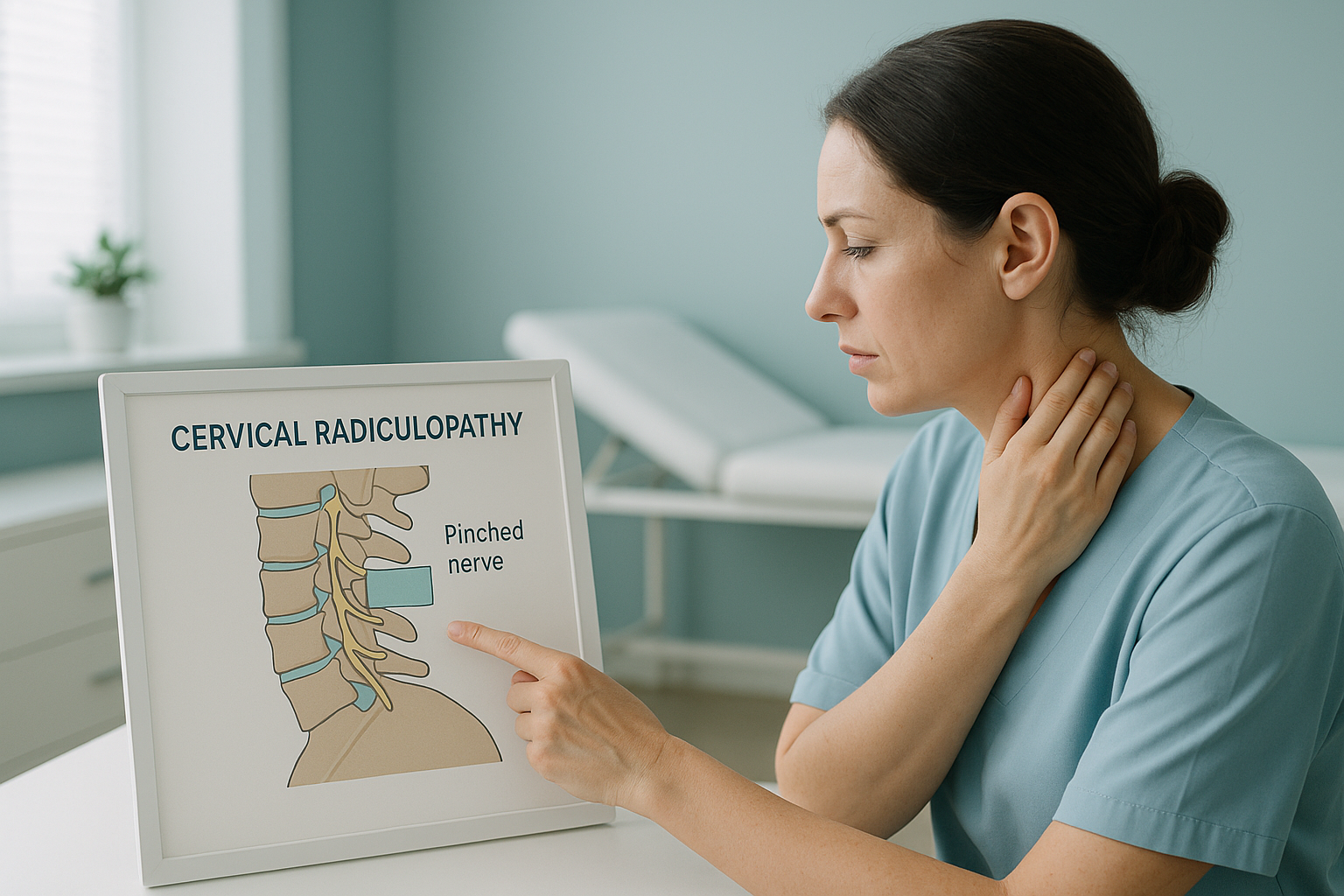
The soft centre of a disc pushes outward and presses on a nearby nerve root.
Wear and tear causes small bony growths that narrow the opening where the nerve exits.
The bony tunnel (foramen) that the nerve passes through becomes too narrow, squeezing the nerve.
These changes are often linked to long-term posture habits, age-related wear, or previous neck injuries. The important thing to understand is that the compression may only become significant when you are upright and gravity is loading your spine, which is why some people have normal-looking scans taken lying down but still have real symptoms.
When should you seek urgent help for neck and arm symptoms?
Most pinched nerves in the neck improve with time and appropriate care. However, some symptoms need urgent medical attention. Contact your GP, call 111, or go to A&E if you experience any of the following:
- Sudden weakness in both arms or legs, or difficulty walking.
- Loss of bladder or bowel control.
- Numbness in the groin or saddle area.
- Rapidly worsening weakness in your arm or hand.
These could indicate pressure on the spinal cord itself (cervical myelopathy), which is different from a single pinched nerve root and requires prompt assessment.
Cervical radiculopathy vs cervical myelopathy
Radiculopathy affects a single nerve root, so symptoms follow one nerve path, usually into one arm. Myelopathy affects the spinal cord itself and can cause wider problems such as balance difficulties, clumsiness in the hands, or symptoms in the legs. The two conditions can sometimes overlap, but myelopathy is considered more serious because the spinal cord does not recover as easily as a single nerve.
How is cervical radiculopathy diagnosed?
Diagnosis usually starts with a clinical examination. Your clinician will test your reflexes, muscle strength and sensation in your arms and hands. They may ask you to turn or tilt your head to see if specific positions reproduce your symptoms. Imaging is used to confirm what is causing the compression.
A note on MRI. EOS imaging shows bones, joints and overall spinal alignment clearly, especially under natural weight-bearing. For soft-tissue detail of discs, nerves and the spinal cord, MRI is usually the better tool. In many cases, both types of imaging together give the most complete picture.
Standard X-rays and MRI are typically taken with you lying down. This position removes the effect of gravity on your spine. Muscles relax, discs decompress slightly, and alignment shifts. The result can look reassuringly normal even when your symptoms are very real.
How does standing imaging help with cervical nerve root compression?
Standing imaging captures your spine in the position where symptoms actually happen, upright and weight-bearing. This matters for cervical radiculopathy because posture and gravity directly influence how much space is available for each nerve root.
An EOS scan images you standing naturally, with your full body weight loading the spine. This shows the true shape of the cervical curve, any forward head position, and how the neck relates to the rest of the spine below. It uses about 90% less radiation than a standard X-ray, around ten times less.
Lying-down scans remove gravity and allow muscles to relax. The cervical curve can flatten, disc spaces may open slightly, and a forward head position disappears. The scan may look normal while the nerve is still being compressed when you stand or sit upright during your daily life.
Your neck does not work in isolation. The cervical spine sits on top of the thoracic spine, which sits on the pelvis and legs. If your pelvis tilts, your lower back compensates, then your upper back adjusts, and finally your neck has to adapt. A whole-body standing image reveals this entire chain. Sometimes the cause of a pinched nerve in the neck is not just local wear and tear, it is a postural imbalance much further down.
Wondering whether a standing alignment assessment could help explain your neck and arm symptoms?
Book a free video consultationWhat generally helps with cervical radiculopathy?
Most people with a pinched nerve in the neck improve within weeks to a few months. The approach depends on how severe the compression is and what is causing it. Common strategies include:
- Activity modification. Avoiding positions that make symptoms worse, such as prolonged overhead reaching or sustained neck extension.
- Physiotherapy. Guided exercises to improve neck mobility, strengthen supporting muscles, and address posture habits that may be contributing.
- Pain management. Your GP can advise on appropriate medication for nerve-type pain.
- Accurate diagnosis. Understanding exactly where and why the nerve is compressed helps your clinician plan the right approach, whether conservative or surgical.
ScanAlign does not provide treatment. It provides the detailed standing alignment images that help your treating clinician see the full picture and make better decisions about your care. You can learn more about how EOS imaging assesses the spine.
Frequently asked questions about cervical radiculopathy
It is a pinched or irritated nerve in your neck. Something, usually a worn disc or a bony spur, presses on the nerve where it exits the spine. This causes pain, tingling or weakness that travels into your shoulder, arm or hand.
Many people improve within six to twelve weeks with appropriate care. Some cases take longer, especially if the underlying cause, such as a significant disc bulge or bony narrowing, is not identified and addressed.
Posture alone does not usually pinch a nerve. However, a sustained forward head position increases the load on the cervical discs and can accelerate wear, making nerve compression more likely over time. A standing alignment assessment can show whether posture is playing a role.
Radiculopathy affects a single nerve root and usually causes symptoms in one arm. Myelopathy affects the spinal cord itself and can cause wider problems including balance issues, leg stiffness, or hand clumsiness. Myelopathy is more serious and needs prompt medical review.
When you lie down, gravity is removed, muscles relax, and the spine decompresses slightly. A forward head position straightens out, and the spaces around nerves can open up. The compression that causes your symptoms when sitting or standing may not be visible in that position.
Yes. An EOS scan uses about 90% less radiation than a standard X-ray, around ten times less. You can find more detail on the safety and FAQs page.
No. ScanAlign accepts self-referrals. You can book a free video consultation directly to discuss whether a standing alignment assessment is appropriate for your symptoms.
Pricing information is available on the FAQs and cost page.
It can, but bilateral symptoms are less common with radiculopathy alone. If both arms are affected, or if you also have leg symptoms or balance problems, that may suggest spinal cord involvement and you should seek prompt medical review.
Gentle neck mobility exercises and nerve glides are commonly recommended by physiotherapists. However, exercises should be guided by a professional who has assessed your specific situation. Getting accurate imaging first helps your physiotherapist target the right area.
Neck and arm pain without a clear diagnosis?
A free video consultation can help you understand whether a standing alignment assessment is the right next step.
Book a free video consultationRelated pages
Sources
- Iyer S, Kim HJ. Cervical radiculopathy. Current Reviews in Musculoskeletal Medicine. 2016;9(3):272-280.
- NHS. Cervical spondylosis (neck pain and stiffness). nhs.uk. Available at: nhs.uk/conditions/cervical-spondylosis.
- The Royal College of Radiologists. iRefer: Making the best use of clinical radiology. 8th ed. London: RCR; 2017.
Written by Abbas Dhami (Specialist Diagnostic Radiographer)
This page is general information and not a diagnosis.
ScanAlign is the trading name of CoreMed Solutions Ltd and operates under The Harley Street Hospital's CQC licence.