
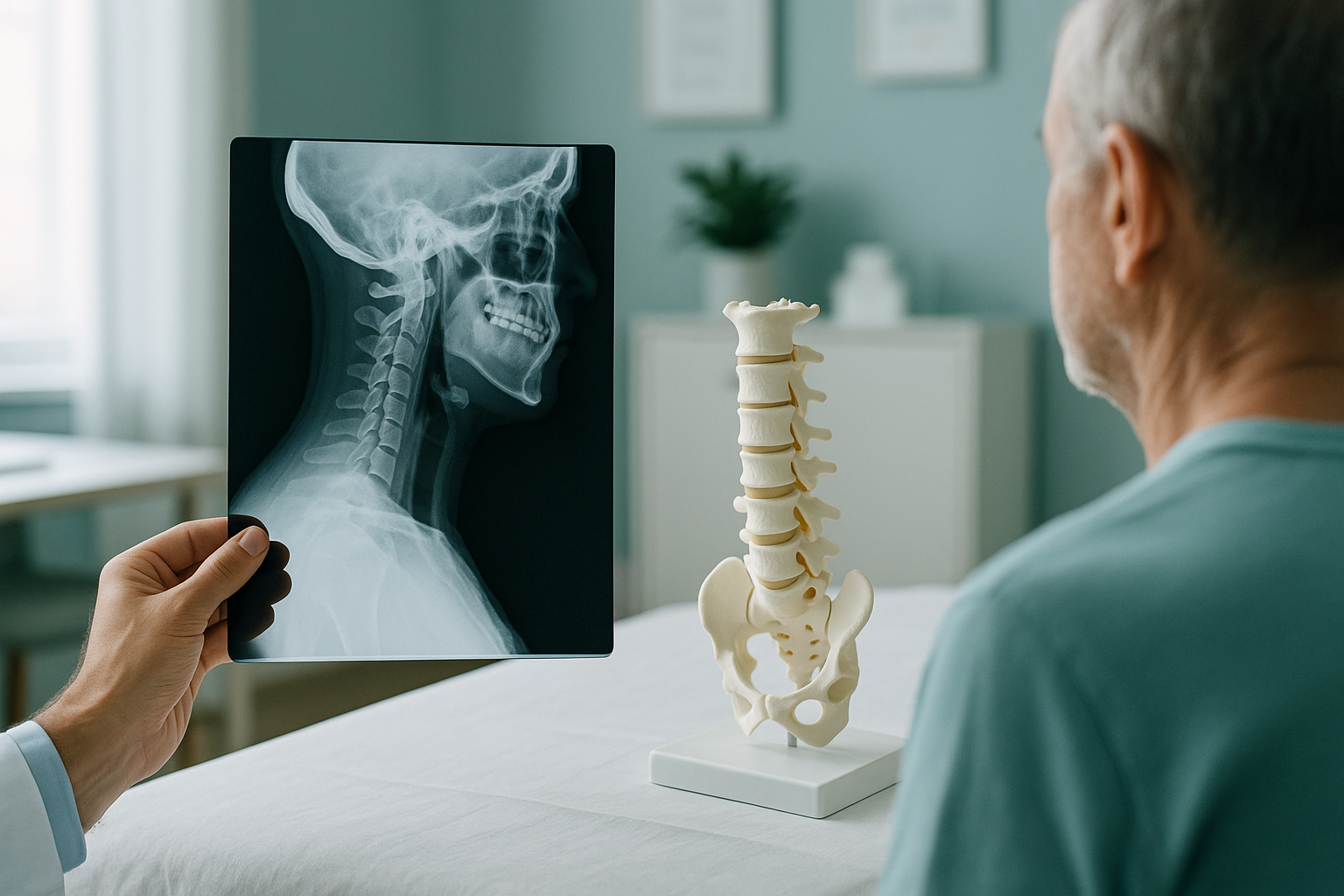
Cervical Spondylosis: What Is Neck Arthritis and Could It Be Causing Your Pain?
Cervical spondylosis is the medical term for wear-and-tear arthritis in the neck. The discs and joints between your neck vertebrae gradually dry out and stiffen with age. Most people over 50 have some degree of cervical spondylotic change, but not everyone gets symptoms. When symptoms do appear, they usually include neck stiffness, aching and sometimes pain that travels into the shoulders or arms.
Key takeaways
- Cervical spondylosis is age-related arthritis of the neck, not an injury or disease you "catch."
- Symptoms range from mild stiffness to pain radiating into the shoulders and arms.
- Lying-down scans can miss alignment problems that only show up when your neck is bearing the weight of your head.
- A standing, whole-body image shows how your neck, upper back and shoulders work together under gravity.
- ScanAlign is a diagnostic imaging clinic. It does not provide treatment, but the images help guide the right next steps.
What are the most common cervical spondylosis symptoms?
The most common cervical spondylosis symptoms are neck stiffness and a dull ache at the back of the neck that may spread to the shoulders. Symptoms tend to build slowly over months or years rather than arriving all at once.
Important: If you notice sudden weakness in your arms or legs, difficulty walking, or any loss of bladder or bowel control, these are red-flag symptoms. Please seek urgent medical attention from your GP, NHS 111 or your nearest A&E department straight away.
What causes cervical spondylotic changes in the neck?
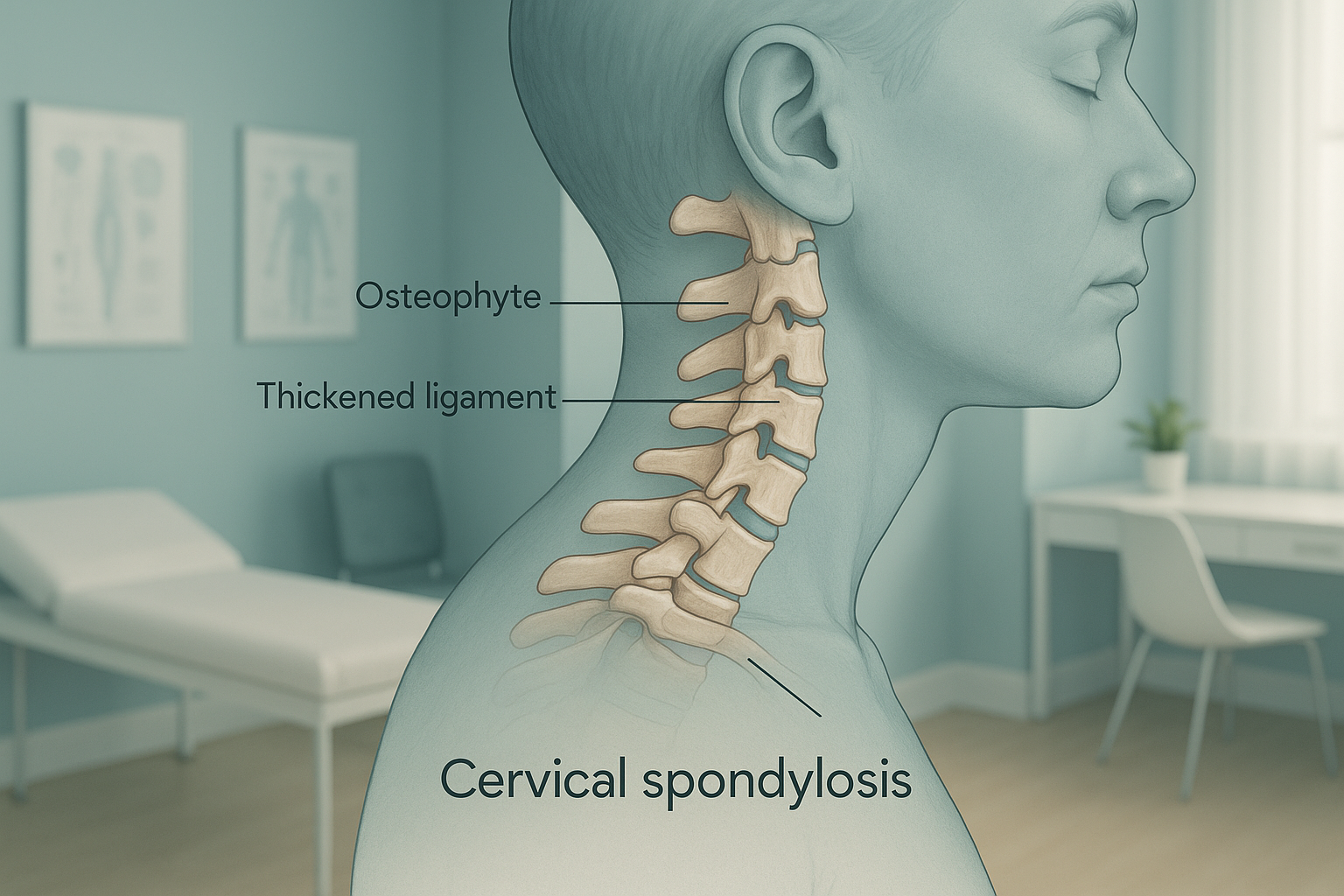
Cervical spondylotic changes happen because the structures in your neck gradually wear down over decades of use. The discs between the vertebrae lose water content and flatten. The joints develop small bony growths called osteophytes. Ligaments can thicken. None of this is unusual. It is part of normal ageing, but certain factors make it more likely to cause symptoms.
Factors that increase your risk
- Age. Cervical spondylotic changes are found in most people over 60, and many people over 40.
- Occupation. Jobs that involve looking down for long periods, such as desk work, dentistry, or hairdressing, place extra load on the cervical spine.
- Previous neck injury. A whiplash injury or other neck trauma can speed up wear and tear in the years that follow.
- Genetics. Some people are simply more prone to degenerative disc disease in the neck.
- Smoking. Research links smoking to faster disc degeneration throughout the spine.
Why does a standing scan show more than a lying-down scan?
A standing scan captures your neck as it actually works, bearing the weight of your head under gravity. When you lie down for a standard X-ray, CT or MRI, your muscles relax and your spine decompresses. That can hide alignment problems and narrowing that only appear when you are upright.
Your body is a connected chain from your feet to the top of your head. If your upper back is too rounded, your neck may push forward to compensate, placing extra load on certain cervical joints. A single-area neck image taken lying down will not show this relationship. A whole-body standing image reveals the full picture.
EOS is a low-dose standing X-ray system. It captures a head-to-foot image in one pass, using about 90% less radiation than a standard X-ray, around ten times less. Because you stand naturally throughout the scan, the image shows your real alignment, not a relaxed, artificial position.
Want to understand how your neck alignment relates to your overall posture? A whole-body standing image can help.
Book a free video consultationWhen MRI is the better choice: EOS shows bones, joints and alignment clearly. For soft tissue detail, such as discs, nerves or the spinal cord itself, MRI is usually the better tool. If your clinician suspects nerve compression, they may recommend MRI alongside or instead of standing imaging.
What is the difference between cervical spondylosis and cervical radiculopathy?
Cervical spondylosis describes the wear and tear itself, the worn discs, stiffened joints and bony spurs. Cervical radiculopathy is what happens when that wear and tear pinches or irritates a nerve root in the neck. Not everyone with spondylosis develops radiculopathy, but spondylosis is the most common cause of it.
If your symptoms include sharp pain, tingling or numbness travelling down one arm, or weakness in the hand, a nerve may be involved. Your GP or specialist can help determine whether radiculopathy is present and which type of imaging is most appropriate.
You can read more about how standing spinal imaging works at ScanAlign.
How is cervical spondylosis usually managed?
Most people with cervical spondylotic symptoms are managed without surgery. Your GP, physiotherapist or specialist will typically recommend a combination of approaches depending on how severe your symptoms are. Common strategies include staying active, gentle neck exercises, pain relief when needed, and ergonomic adjustments at work.
Accurate imaging plays an important role in guiding these decisions. Understanding exactly where the wear and tear is, how your neck sits relative to the rest of your spine, and whether any nerves are being crowded helps your treating clinician choose the right approach for you.
ScanAlign does not provide treatment. It provides the diagnostic imaging that your clinician or specialist can use to plan your care. No referral is needed to book.
For details on pricing, visit the FAQs and cost information page.
Frequently asked questions about cervical spondylosis
Yes. Cervical spondylosis is simply the medical name for osteoarthritis affecting the cervical spine, which is the section of your spine in the neck. It involves the same type of gradual wear and tear that affects other joints like the knees or hips.
Most people begin to develop some cervical spondylotic changes from their 40s onward. By age 60, the majority of adults will show signs on imaging. However, having changes on a scan does not automatically mean you will have symptoms.
Yes. Cervical spondylosis can trigger headaches that start at the base of the skull and spread upward, sometimes called cervicogenic headaches. They are caused by referred pain from stiff or irritated structures in the upper neck.
No. ScanAlign is a private, self-pay clinic and you can book directly without a referral. Many people come to us after waiting a long time for NHS imaging, or because they want a full standing assessment that is not available through their usual pathway.
Yes. The EOS system uses about 90% less radiation than a standard X-ray, around ten times less. You can find more details about safety on the FAQs page.
EOS is an X-ray based system, so it shows bones, joints and overall alignment very clearly. It does not show soft tissue detail like disc bulges or nerves. For that level of detail, MRI is the appropriate scan. EOS and MRI answer different questions and sometimes both are useful.
Some people with cervical spondylosis report dizziness or unsteadiness, though the exact link is debated among clinicians. If you experience dizziness alongside neck symptoms, it is worth discussing with your GP to rule out other causes.
Gentle range-of-motion exercises, chin tucks and neck stretches are commonly recommended by physiotherapists. ScanAlign is a diagnostic clinic, not a treatment provider, so we would always suggest working with a qualified physiotherapist who can tailor exercises to your imaging findings.
You can find up-to-date pricing on our FAQs and cost page. The free video consultation is a good first step to find out which scan is right for you.
You will speak with our team to discuss your symptoms and concerns. They will explain whether a standing alignment scan is likely to be helpful for you, with no obligation to go ahead. You can book one here.
See how your neck alignment connects to your whole spine
A free video consultation will help you understand whether standing imaging is the right next step for your neck symptoms.
Book a free video consultation Learn more about EOS imagingSources
- NHS. "Cervical spondylosis." nhs.uk. Available at: https://www.nhs.uk/conditions/cervical-spondylosis/
- Iyer S, Kim HJ. "Cervical radiculopathy." Current Reviews in Musculoskeletal Medicine, 2016;9(3):272-280.
- Theodore N. "Degenerative cervical spondylosis." The New England Journal of Medicine, 2020;383(2):159-168.
Written by Abbas Dhami (Specialist Diagnostic Radiographer)
This page is general information and not a diagnosis.
ScanAlign is the trading name of CoreMed Solutions Ltd and operates under The Harley Street Hospital's CQC licence.