

Cervical Myelopathy: What Is It and How Do You Know You Have It?
Cervical myelopathy is a condition where the spinal cord in your neck becomes compressed, usually by wear-and-tear changes in the bones or discs. It can cause clumsiness in the hands, difficulty walking and altered sensation. It tends to get worse over time, so early recognition matters.
Key takeaways
- Cervical myelopathy is caused by compression of the spinal cord itself, not just a single nerve.
- Early signs are often subtle, such as clumsy hands, stiff legs or poor balance.
- It differs from radiculopathy, which affects a nerve root and usually causes pain down one arm.
- Standing, weight-bearing imaging can reveal how spinal alignment changes under gravity, which lying-down scans may not show.
- If you notice sudden weakness, loss of bladder or bowel control, or rapidly worsening symptoms, seek urgent medical attention.
Your spinal cord is the main nerve highway running from your brain down through the bones in your neck. When those bones, discs or ligaments narrow the space around the cord, the cord gets squeezed. That squeezing is called cervical myelopathy, and because the spinal cord carries signals to your whole body, the effects can be surprisingly wide-ranging.
The most common form is cervical spondylotic myelopathy, sometimes called degenerative cervical myelopathy. It develops gradually as the spine ages. Bone spurs grow, discs bulge, ligaments thicken, and the canal that protects the cord slowly shrinks. Many people do not realise anything is wrong until everyday tasks become noticeably harder.
What are the early signs of cervical myelopathy?
The earliest signs are often subtle changes in hand coordination and balance. You might struggle with buttons, drop things more often, or feel unsteady on your feet, particularly in the dark. These clues are easy to dismiss but worth paying attention to.
Some people also notice an electric-shock feeling running down their spine when they bend their head forward. This is called Lhermitte's sign and is a recognised symptom of spinal cord compression in the neck. Pain is not always the main feature. Many people experience more functional problems, such as difficulty with grip or walking, than outright pain.
What causes cervical myelopathy?
The most common cause is age-related wear and tear in the cervical spine. Over time, several changes can narrow the spinal canal and press on the cord.
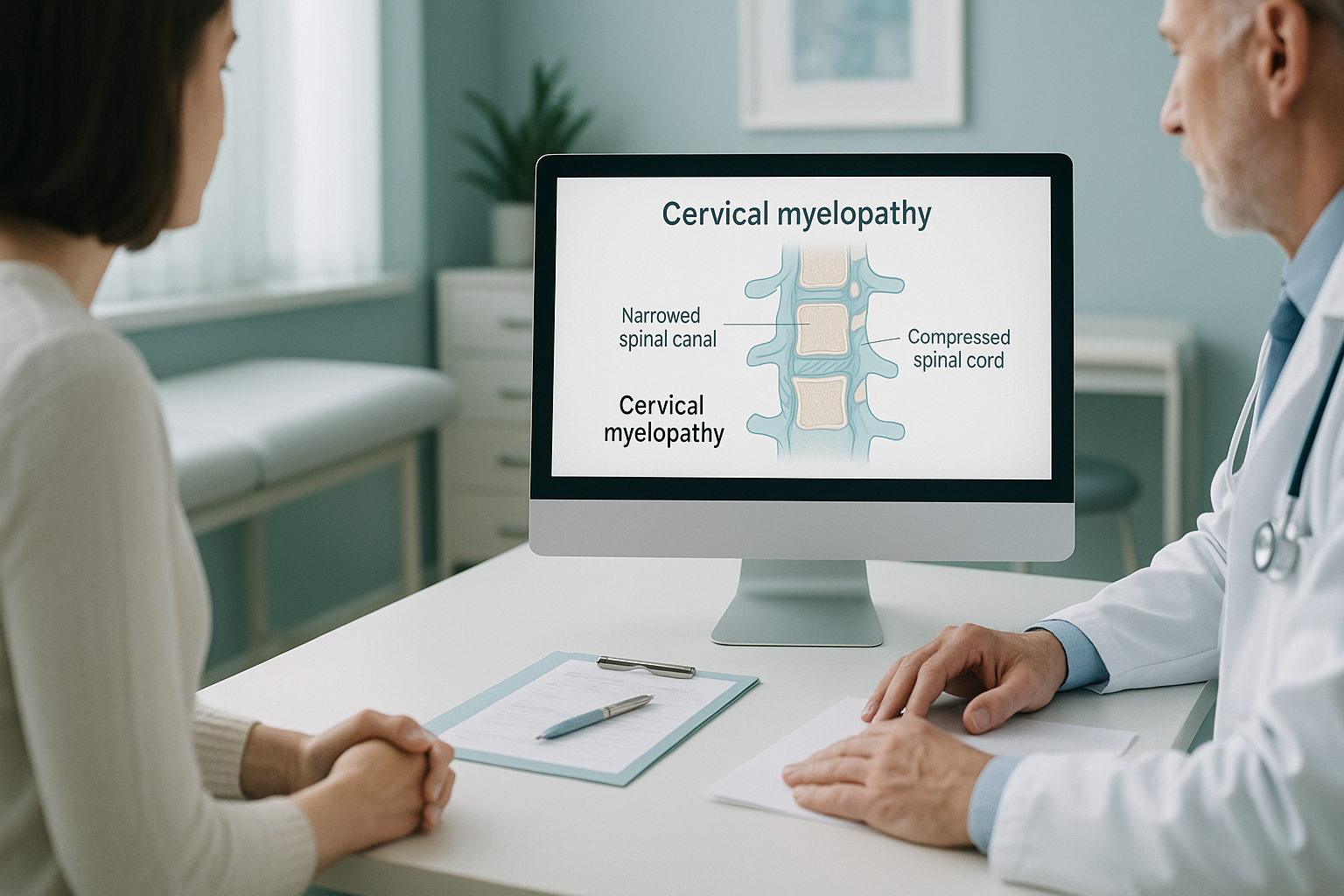
Some people are born with a naturally narrower spinal canal. They may have no symptoms for decades, but the added wear-and-tear changes of ageing tip things over the threshold. Poor posture and alignment can also play a part. When the cervical spine loses its natural curve, extra load falls on certain segments, accelerating the wear.
When should you seek urgent help for cervical myelopathy symptoms?
You should seek urgent medical attention if you develop any of the following. These may indicate rapidly worsening spinal cord compression that needs prompt assessment.
Seek urgent help (GP, 111, or A&E) if you notice:
- Sudden or rapidly worsening weakness in your arms or legs
- Loss of bladder or bowel control
- Numbness spreading quickly or affecting both sides of your body
- Difficulty walking that appears suddenly rather than gradually
These red-flag symptoms do not always mean the worst, but they need prompt medical review. Do not wait for a routine appointment or an imaging scan.
What is the difference between cervical myelopathy and radiculopathy?
Cervical myelopathy affects the spinal cord itself, while cervical radiculopathy affects a single nerve root branching off the cord. They can occur together, but the pattern of symptoms is different.
- Both hands affected
- Balance and walking problems
- Clumsiness rather than sharp pain
- Symptoms in arms and legs
- Usually one arm affected
- Sharp, shooting pain down the arm
- Specific area of numbness or weakness
- Legs usually unaffected
Both conditions involve the cervical spine, and sometimes imaging reveals compression at more than one level. Understanding which structure is affected helps guide what kind of specialist you may need to see. You can read more about how the spine works as a connected chain on our spine page.
How does standing imaging help assess cervical myelopathy?
Standing, weight-bearing imaging shows how your spine behaves under gravity, the way it works in real life. When you lie down for a conventional scan, gravity is removed, muscles relax, and the spine can settle into a position that hides alignment problems.
Your body is a connected chain from your feet to your head. If your lower back has lost its curve, or your pelvis is tilted, your neck may compensate by shifting forward to keep your head balanced. That forward shift narrows the spinal canal further. A lying-down scan would not show this extra narrowing because the compensating posture disappears when you are flat.
An EOS scan captures a full standing image from head to toe in one pass, using about 90% less radiation than a standard X-ray, around ten times less. It lets a specialist see the whole alignment picture, not just the neck in isolation. The result is a clearer view of how much the canal may be narrowing when you are upright.
Not sure whether a standing alignment scan would add useful information for your cervical spine? A free video consultation can help you decide.
Book a free video consultationA note about MRI. EOS shows bones, joints and alignment very well. For soft-tissue detail, such as viewing the spinal cord itself, the discs or the nerves, MRI is usually the better tool. Many people benefit from both types of imaging. Your clinician can advise which combination makes sense for you.
What are the treatment options for cervical myelopathy?
Treatment depends on how severe the compression is and how quickly symptoms are progressing. A specialist, usually a spinal surgeon or neurologist, will decide the best approach based on clinical examination and imaging.
In mild or very early cases, monitoring and physiotherapy may be recommended to maintain mobility and strength. When the cord compression is more significant or symptoms are getting worse, surgery to decompress the spinal canal is often considered. The aim of surgery is to stop further deterioration and, where possible, allow some recovery.
Accurate imaging plays a key role in these decisions. Understanding the full alignment of the spine, not just the affected vertebrae, helps the surgical team plan the best approach. For details on what an EOS alignment assessment includes, visit our overview page.
Frequently asked questions about cervical myelopathy
It is a condition where the spinal cord in your neck gets squeezed, usually by age-related changes in the bones, discs or ligaments. This pressure interferes with the signals travelling between your brain and the rest of your body.
It is the most common type of cervical myelopathy. "Spondylotic" means it is caused by spondylosis, the normal wear and tear that happens in the spine as you get older. Bone spurs, disc bulging and ligament thickening all contribute.
Cervical myelopathy tends to be a progressive condition, meaning it usually stays the same or gets worse over time rather than improving by itself. That is why early recognition and specialist review are important.
A trapped nerve (radiculopathy) affects one nerve root and usually causes pain or weakness in one arm. Myelopathy compresses the spinal cord itself, so it can affect both arms, both legs, balance and coordination.
No. ScanAlign is a private, self-pay clinic and you can book directly without a GP or consultant referral. You start with a free video consultation to discuss whether a standing alignment scan is appropriate for you.
Yes. An EOS scan uses about 90% less radiation than a standard X-ray, around ten times less. You can read more about safety, cost and what to expect on our FAQs page.
An EOS scan captures a full standing image from head to toe in one pass, so a specialist can see how your whole skeleton aligns under gravity. A standard X-ray usually images just one area and often with you lying down.
Poor posture alone does not cause myelopathy, but it can contribute. A forward head position increases the load on the cervical spine and may accelerate the wear-and-tear changes that narrow the canal over time.
Pricing details are on our FAQs page. A free video consultation is always the first step, so you can discuss what imaging is right for you before committing.
ScanAlign is at 19 Harley Street, London, within The Harley Street Hospital. The nearest Underground stations are Oxford Circus and Regent's Park.
Wondering if your neck symptoms are alignment-related?
A free video consultation with our specialist radiographer can help you understand whether a standing alignment scan would add useful information for your case.
Book a free video consultationWritten by Abbas Dhami (Specialist Diagnostic Radiographer)
Sources
- Fehlings MG, et al. A Clinical Practice Guideline for the Management of Degenerative Cervical Myelopathy. Global Spine Journal, 2017;7(3 Suppl):21S-34S.
- NHS. Cervical spondylosis. nhs.uk/conditions/cervical-spondylosis.
- Karadimas SK, et al. Pathophysiology and Natural History of Cervical Spondylotic Myelopathy. Spine, 2013;38(22 Suppl 1):S21-S36.
This page is general information and not a diagnosis.
ScanAlign is the trading name of CoreMed Solutions Ltd and operates under The Harley Street Hospital's CQC licence.