
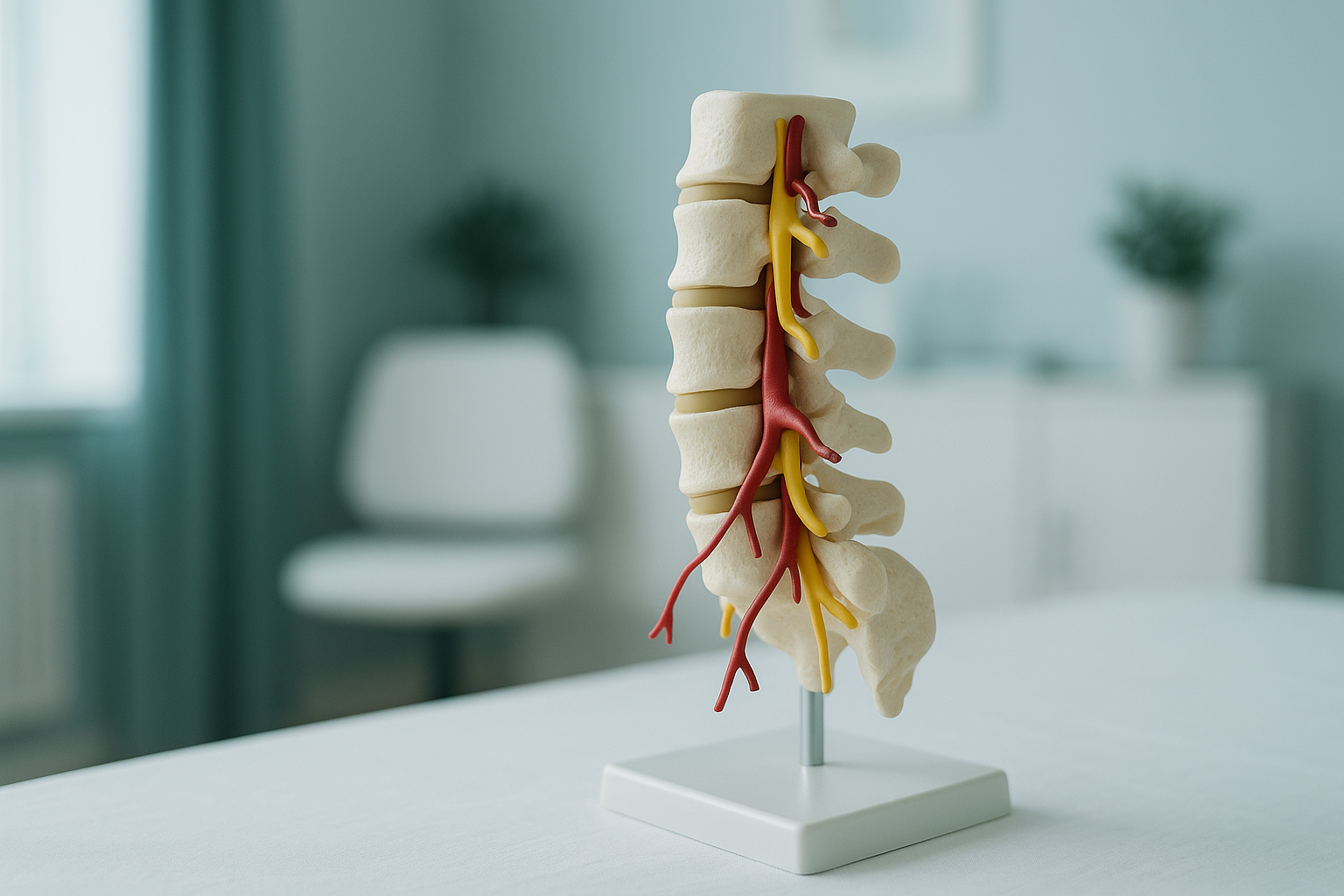
Cervical Radiculomyelopathy: What Happens When Both Nerve Roots and the Spinal Cord Are Compressed?
Cervical radiculomyelopathy is a condition where the spinal cord and one or more nerve roots in the neck are compressed at the same time. It causes a mix of symptoms, including arm pain, hand clumsiness and difficulty with balance or walking. Because both structures are involved, the pattern is more complex than either problem alone.
Key takeaways
- Cervical radiculomyelopathy combines nerve root compression (radiculopathy) with spinal cord compression (myelopathy) in the neck.
- Symptoms often include arm pain or tingling alongside balance problems, stiffness in the legs or difficulty with fine hand movements.
- It is usually caused by age-related wear in the cervical spine, such as disc bulges and bony overgrowth.
- Standing, weight-bearing imaging can reveal alignment issues that lying-down scans may miss.
- Some symptoms are red flags that need urgent medical attention.
You may already have heard of radiculopathy, where a nerve root in the neck is pinched, or myelopathy, where the spinal cord itself is squeezed. Cervical radiculomyelopathy is the term used when both happen together. It is sometimes called cervical myeloradiculopathy. Because the cord and roots share a tight space inside the spinal canal, the same underlying problem, such as a bulging disc or bony spur, can compress both at once.
Understanding this combination matters. Nerve root symptoms like sharp arm pain tend to grab your attention, but cord involvement can be more subtle, showing up as clumsiness in the fingers or a vague unsteadiness when walking. If the cord symptoms are missed, the condition can progress.
What are the symptoms of cervical radiculomyelopathy?
Symptoms come from two sources. The compressed nerve root causes pain, tingling or weakness in a specific part of the arm or hand. The compressed spinal cord causes broader problems with coordination, balance and fine motor control. You may notice some of these together.
The key feature of cervical radiculomyelopathy is this mix. Arm pain (from the nerve root) alongside coordination or gait problems (from the cord) is the hallmark. Symptoms may develop gradually over months or years, which makes them easy to dismiss or attribute to normal ageing.
What causes radiculopathy and myelopathy together?
The most common cause is age-related wear and tear in the cervical spine, often called cervical spondylosis. As the discs lose height and the joints stiffen, the space available for the spinal cord and nerve roots narrows. Several changes can happen at the same time.
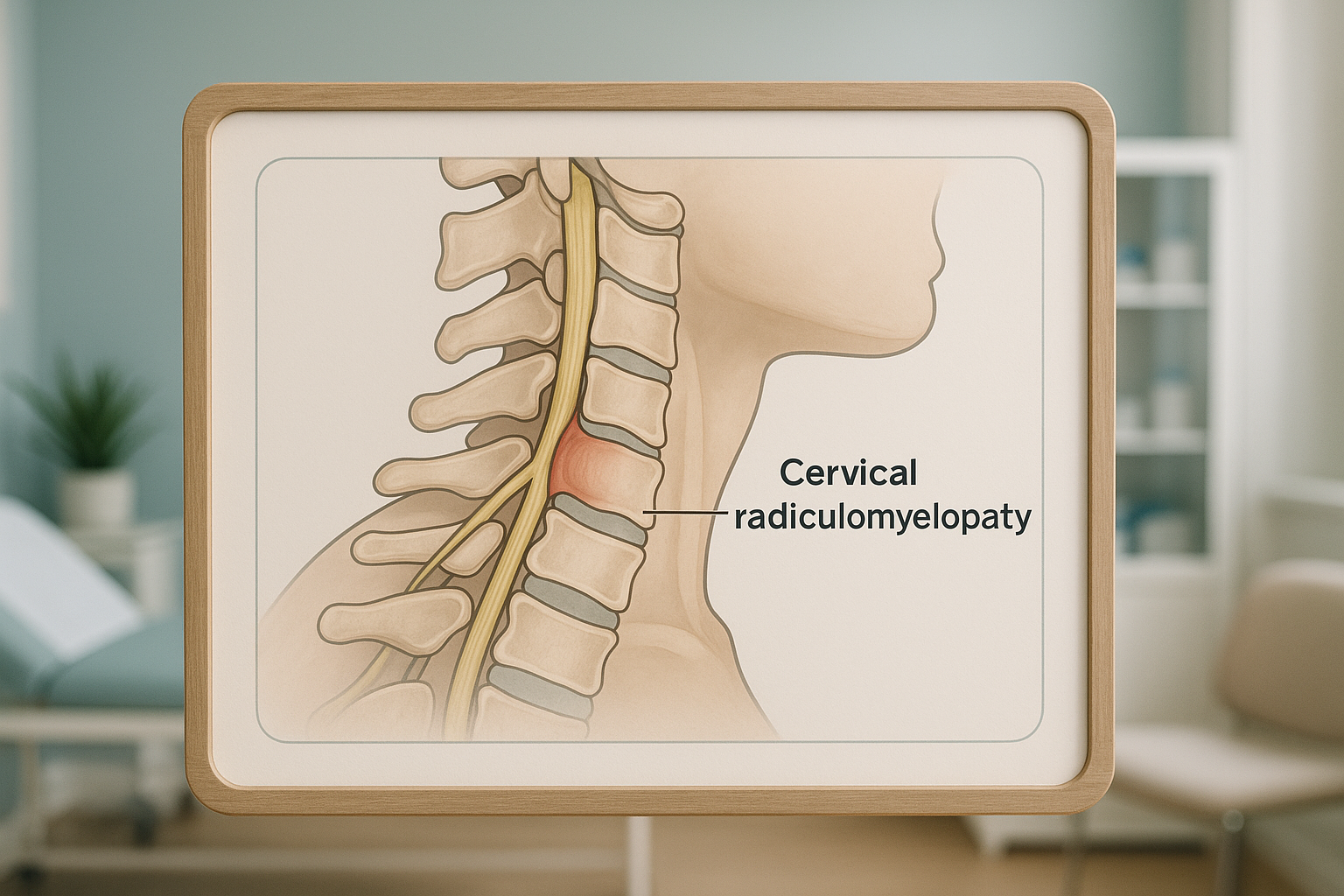
- Disc bulges or herniations. A disc that pushes backward into the spinal canal can press on the cord centrally and on a nerve root to one side.
- Bony spurs (osteophytes). Extra bone growth around the joints narrows the canal and the small openings where nerves exit.
- Thickened ligaments. The ligaments that line the canal can thicken with age, further reducing space.
- A naturally narrow canal. Some people are born with a spinal canal that is narrower than average, making them more vulnerable to compression even with mild degenerative changes.
Because these changes are gradual, spondylotic myeloradiculopathy is most common in adults over 50. However, earlier disc problems or injury can bring it on sooner.
When should you seek urgent help for neck and arm symptoms?
Some symptoms suggest the spinal cord is under significant pressure. If you notice any of the following, contact your GP, call 111, or go to A&E straight away. Do not wait for a routine scan.
- Loss of bladder or bowel control, or new difficulty starting or stopping.
- Sudden weakness in both legs or difficulty standing.
- Numbness in the groin or saddle area.
- Rapidly worsening hand weakness or loss of grip.
These are medical emergencies. Most people with cervical radiculomyelopathy do not experience them, but it is important to know the warning signs.
How does standing imaging help assess cervical cord and nerve root compression?
Standing, weight-bearing imaging shows your spine under real-life load. When you lie down for a standard scan, gravity is removed, your muscles relax, and the spaces in your spine can open up slightly. This means a lying-down image may underestimate the narrowing that is actually happening when you are upright.
Your body is a connected chain. The way your pelvis tilts, how your thoracic spine curves and the position of your head all affect the loading on your cervical spine. A forward head posture, for example, increases the strain on the neck and can worsen compression. These alignment relationships only show up on a full-length standing image, not on a scan of one small area taken lying down.
An EOS scan captures the full skeleton from head to feet in a standing position, using about 90% less radiation than a standard X-ray, around ten times less. This whole-body view lets a specialist see how your overall alignment may be contributing to the compression in your neck.
Wondering whether your neck symptoms could be linked to your wider alignment? A free video consultation can help you decide if standing imaging is the right next step.
Book a free video consultationA note about MRI. EOS shows bones, joints and overall alignment clearly. For soft tissue detail, such as discs, the spinal cord itself, or nerves, MRI is usually the better tool. In many cases of cervical radiculomyelopathy, both types of imaging are helpful. EOS reveals the alignment picture, while MRI shows what is happening inside the canal. Your specialist may recommend one or both.
What helps if you suspect cervical radiculomyelopathy?
Getting clear imaging is an important first step. When both the spinal cord and nerve roots are involved, your treating clinician needs to understand the full picture before recommending any course of action. That means knowing not just where the compression is, but how your overall spinal alignment may be contributing to it.
ScanAlign is a diagnostic imaging clinic. We do not provide treatment or diagnose conditions. What we do is provide detailed, standing, weight-bearing images and a comprehensive report that your specialist, surgeon or physiotherapist can use to plan your care.
You can learn more about how standing imaging works for spine conditions or read about the EOS scan itself.
No referral is needed. For details on what the scan costs, preparation and what to expect, visit the FAQs and cost page.
Frequently asked questions
Radiculopathy means a nerve root is compressed, causing pain, tingling or weakness in a specific area of the arm or hand. Myelopathy means the spinal cord is compressed, causing broader problems like balance trouble, leg stiffness or clumsy hands. Cervical radiculomyelopathy is when both happen together.
It can. Myelopathy in particular tends to progress gradually if the compression on the cord is not addressed. Early assessment is important so that any changes can be monitored and managed by your treating clinician.
Not exactly. Cervical spondylosis refers to age-related wear and tear in the neck. Radiculomyelopathy is one possible consequence of that wear, occurring when the narrowing becomes severe enough to compress the cord and nerve roots. Many people have spondylosis without developing myelopathy or radiculopathy.
When you lie down, gravity is removed and the spine can decompress slightly. Standing imaging shows the spine under your actual body weight, which may reveal narrowing or misalignment that relaxes away on a lying-down scan. It also shows how your whole alignment, from head to feet, affects the neck.
No. ScanAlign is a private, self-pay clinic. You can book directly without a GP or consultant referral.
An EOS scan uses about 90% less radiation than a standard X-ray, around ten times less. This makes it a very low-dose option for full-body imaging.
They show different things. EOS shows bone alignment and joint positioning while you are standing. MRI shows soft tissue detail such as discs, the spinal cord and nerves. For radiculomyelopathy, both are often useful and provide complementary information.
For up-to-date pricing and what is included, please visit the FAQs and cost page.
A short, no-obligation video call where you can discuss your symptoms and ask whether a standing EOS scan would be helpful for your situation. There is no pressure to book.
ScanAlign is based at 19 Harley Street, London. It operates under The Harley Street Hospital's CQC licence.
Not sure if your symptoms are connected?
A free, no-obligation video consultation can help you understand whether standing imaging would add to your clinical picture.
Book a free video consultationWritten by Abbas Dhami (Specialist Diagnostic Radiographer)
Sources
- NHS. Cervical spondylosis. nhs.uk (accessed 2024).
- Nouri A, Tetreault L, Singh A, et al. Degenerative cervical myelopathy: epidemiology, genetics, and pathogenesis. Spine. 2015;40(12):E675-E693.
- The Royal College of Radiologists. iRefer: Making the best use of clinical radiology. rcr.ac.uk (accessed 2024).
This page is general information and not a diagnosis.
ScanAlign is the trading name of CoreMed Solutions Ltd and operates under The Harley Street Hospital's CQC licence.