
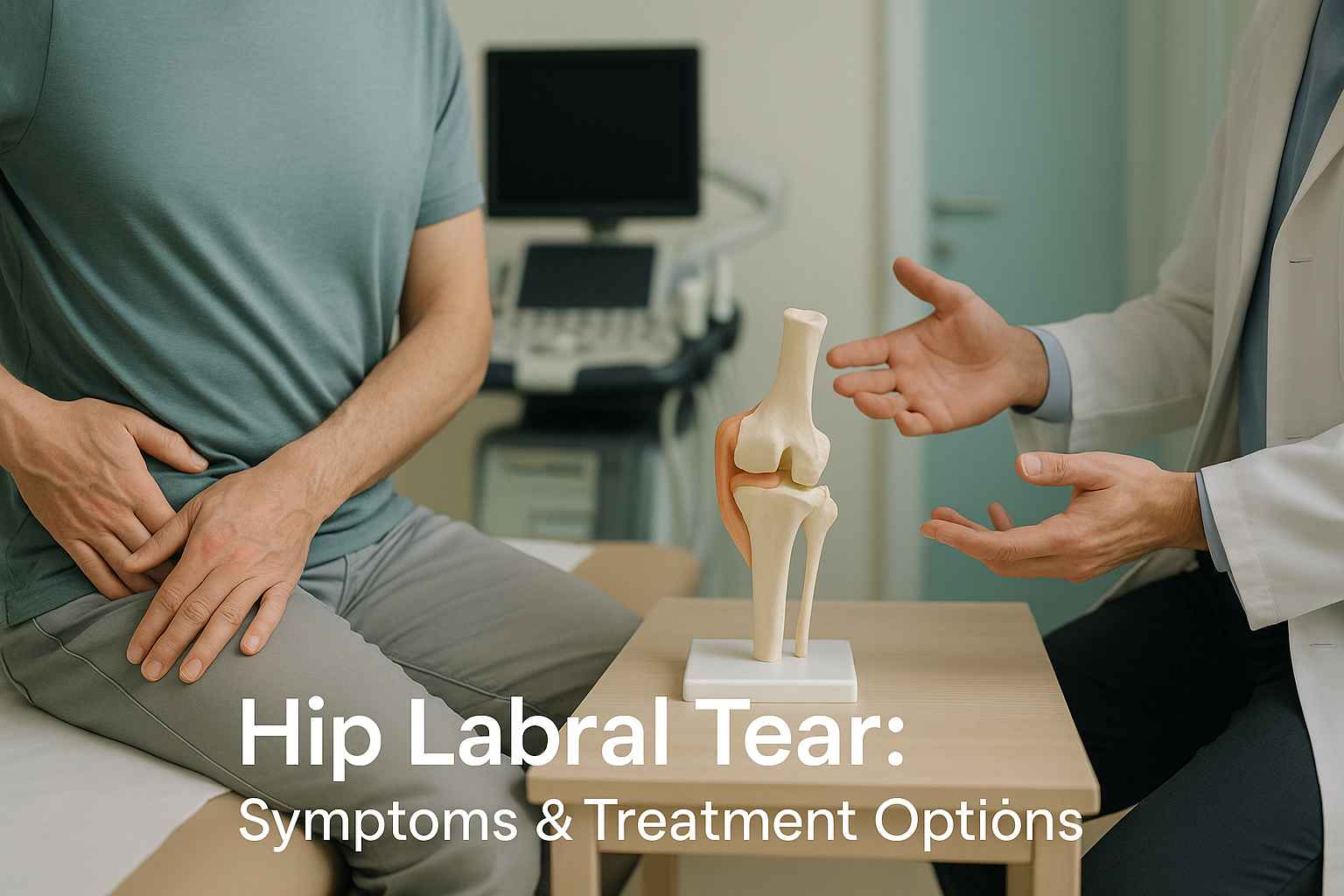
Hip Labral Tear: What Are the Symptoms and How Is It Treated?
A hip labral tear is damage to the ring of cartilage (the labrum) that lines the rim of your hip socket. It causes deep groin or hip pain, clicking, and stiffness. Treatment ranges from physiotherapy and targeted exercises to surgery, depending on the severity. Understanding your whole-body alignment can help identify what is putting extra stress on the labrum.
Key takeaways
- The labrum is a tough cartilage ring that deepens the hip socket and cushions the joint.
- Common symptoms include deep groin pain, clicking, catching and reduced range of movement.
- Many labral tears improve with physiotherapy, but some need arthroscopic surgery.
- Standing imaging can reveal alignment issues in the pelvis, spine or legs that contribute to labral stress.
- EOS is a type of imaging that shows your bones and joints while you are upright and weight-bearing.
If you have been told you have a hip labral tear, or you suspect one, you probably want to know what it means for your daily life and what you can do about it. This page explains the condition in plain language, covers the main treatment options, and shows why looking at your whole alignment matters.
What does a hip labral tear feel like?
A hip labral tear typically causes a deep, dull ache in the groin or front of the hip. Some people also feel sharp catching or clicking with certain movements. The pain often gets worse after sitting for a long time, walking on uneven ground, or twisting at the hip.
A persistent ache in the front of the hip or groin area, often hard to pinpoint.
A sensation of something catching inside the hip joint during movement.
Reduced range of movement, especially when rotating the hip inward or outward.
Discomfort that flares up after long periods of sitting or driving.
Not everyone with a labral tear has all these symptoms. Some people have a tear that causes no problems at all and is found by chance on a scan. If your symptoms are affecting your daily routine, it is worth investigating further.
A note on soft-tissue imaging: EOS standing X-rays show bones, joints and alignment beautifully. For seeing the labrum itself (soft tissue), MRI is usually the better tool. Many people benefit from both types of imaging, as each gives your clinician different information.
What causes a hip labral tear?
A hip labral tear is caused by damage to the labrum from structural issues, repetitive movement, or an acute injury. In many cases, the shape of the hip bones themselves puts extra pressure on the labrum over time.
Femoroacetabular impingement, where extra bone on the hip socket or thigh bone creates friction.
Sports involving twisting, pivoting or deep squatting can gradually wear the labrum down.
A fall, a sudden twist, or a car accident can tear the labrum in one event.
A pelvic tilt or leg length difference shifts load unevenly onto one hip over years.
Because the body works as a connected chain from feet to head, a problem elsewhere, such as a pelvic tilt or a difference in leg length, can shift extra load onto one hip. Over time, this uneven stress can contribute to labral damage. That is why looking at the hip in isolation sometimes misses the bigger picture.
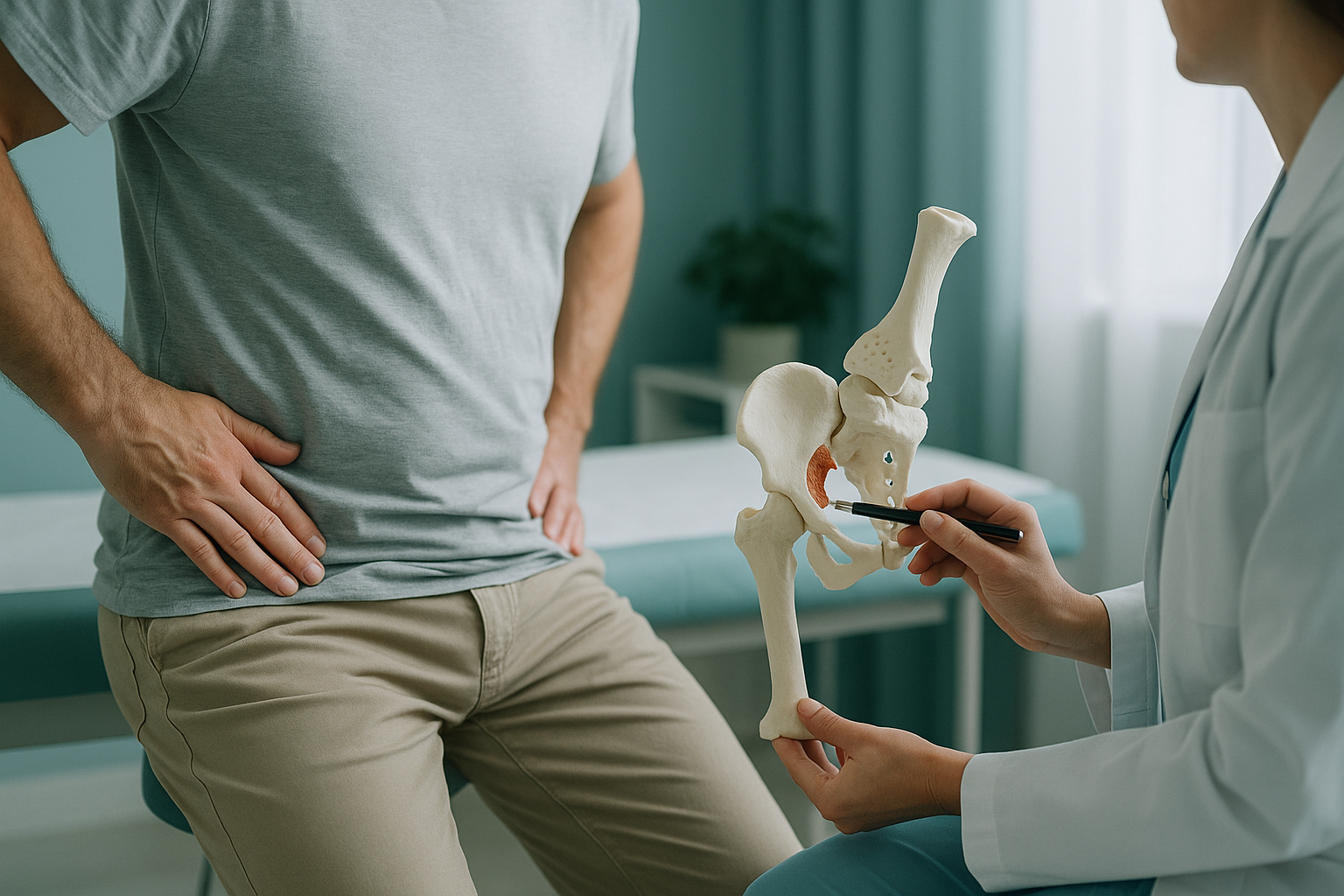
How is a hip labral tear diagnosed?
A hip labral tear is usually diagnosed through a combination of a clinical examination and imaging. Your clinician may perform specific tests where they move your hip into certain positions to see if they reproduce your pain. MRI (often with a contrast dye injected into the joint) is the standard imaging tool for seeing the labrum itself.
However, imaging the labrum alone does not explain why it tore. Standard scans are done lying down. When you lie flat, your muscles relax, your pelvis settles, and alignment problems that show up during normal standing and walking can disappear from the image entirely.
This is where standing, weight-bearing imaging adds real value. An EOS scan captures your entire skeleton, from your head to your feet, while you are upright. It shows how your pelvis sits, whether your legs are the same length under load, and how your spine and hips relate to each other. This information helps your treating clinician understand the mechanical forces acting on your hip, which a lying-down scan simply cannot provide.
Wondering whether your hip alignment could be contributing to your symptoms? A short video call can help you decide if a standing scan is worthwhile.
Book a free video consultationCan a hip labral tear heal without surgery?
Some hip labral tears can improve significantly without surgery, especially smaller tears or those that are not causing mechanical symptoms like locking. Non-surgical management typically includes physiotherapy, activity modification, and targeted exercises to strengthen the muscles around the hip.
Non-surgical approaches
- Physiotherapy: A structured programme focusing on hip stability, core strength, and movement control.
- Hip labral tear exercises: Targeted movements to strengthen the gluteal muscles and deep hip stabilisers, reducing load on the damaged labrum.
- Activity modification: Avoiding positions and activities that aggravate symptoms while you build strength.
- Pain management: Anti-inflammatory medication, guided by your GP or consultant.
When surgery might be considered
If non-surgical treatment does not improve your symptoms after several months, or if you have mechanical symptoms such as the hip locking or giving way, your consultant may discuss arthroscopic (keyhole) surgery. This can involve repairing or trimming the torn labrum, and sometimes reshaping the bone if impingement is present.
Recovery time after hip labral tear surgery varies. Most people need several months of rehabilitation to return to full activity. Your surgeon and physiotherapist will guide this process.
Important: ScanAlign is a diagnostic imaging clinic. We do not provide treatment. The information above is general guidance. Your treating clinician will recommend the best plan for your situation.
Why does whole-body alignment matter for a hip labral tear?
Whole-body alignment matters because your hip does not work in isolation. The way your pelvis is positioned, the curve of your lower spine, and the length and angle of your legs all influence the forces passing through your hip joint. When something is off, your body compensates. Pain often appears at the point that is absorbing extra stress, not at the original cause.
For example, a slight pelvic tilt can change the angle at which the thigh bone sits in the socket. Over time, this shifts load onto the labrum unevenly. A standard lying-down scan of the hip may show the tear itself, but it cannot show the alignment pattern that contributed to it.
An EOS standing scan captures your full skeleton while you are upright and weight-bearing. It uses about 90% less radiation than a standard X-ray, around ten times less. The resulting image lets your clinician see your alignment as it truly is during daily life, not as it appears when you are relaxed on a table.
This kind of information can help your surgeon or physiotherapist plan treatment more precisely. It does not replace MRI for seeing the labrum itself, but it adds a layer of understanding that lying-down imaging misses. You can read more about hip alignment imaging on our dedicated page.
Frequently asked questions about hip labral tears
Most people describe a deep ache in the groin or front of the hip that gets worse with longer walks. Some also feel a catching or clicking sensation, especially on uneven surfaces or when changing direction.
The labrum has limited blood supply, so it does not heal easily by itself. However, many people manage their symptoms well with physiotherapy and targeted exercises, and some tears stop causing problems altogether. Surgery is usually only considered after conservative treatment has been tried.
Recovery varies depending on the procedure and the individual. Most people use crutches for a few weeks and follow a rehabilitation programme for several months. Full return to sport or demanding activities can take six months or longer.
Exercises that strengthen the gluteal muscles, hip stabilisers and core are generally recommended. Your physiotherapist will tailor a programme to your specific tear and symptoms. It is best to avoid deep squats, heavy impact and end-range hip movements until guided otherwise.
The most common clinical test is called the FADIR test. Your clinician flexes your hip, then rotates it inward while applying gentle pressure. If this reproduces your deep hip or groin pain, it suggests labral involvement. An MRI is usually needed to confirm the diagnosis.
EOS shows bones, joints and alignment. It cannot directly image the labrum, which is soft tissue. MRI is the tool for that. However, EOS reveals alignment factors such as pelvic tilt or leg length differences that may be contributing to the labral stress.
Yes. EOS uses about 90% less radiation than a standard X-ray, around ten times less. You can find more details about safety on our FAQs page.
No. ScanAlign is a private self-pay clinic, so you can refer yourself. The process starts with a free video consultation to check that a standing scan is the right next step for you.
Pricing details are available on our FAQs and cost page.
Over time, a significant labral tear can reduce the protective cushioning in the hip joint, which may increase the risk of cartilage wear and eventually osteoarthritis. This is one reason why understanding and addressing the underlying cause early is important.
Understand what is putting stress on your hip
A free video consultation with our team can help you decide whether standing alignment imaging is the right next step.
Book a free video consultationSources
- Groh MM, Herrera J. A comprehensive review of hip labral tears. Current Reviews in Musculoskeletal Medicine. 2009;2(2):105-117.
- NHS. Hip pain in adults. nhs.uk/conditions/hip-pain.
- Illés T, Somoskeöy S. The EOS imaging system and its uses in daily orthopaedic practice. International Orthopaedics. 2012;36(7):1325-1331.
Written by Abbas Dhami (Specialist Diagnostic Radiographer)
This page is general information and not a diagnosis.
ScanAlign is the trading name of CoreMed Solutions Ltd and operates under The Harley Street Hospital's CQC licence.