

Combined Hip and Knee Replacement: What Should You Know Before Surgery?
Some people need both a hip and a knee replaced, either at the same time or in separate operations. Getting the right imaging beforehand is important because the hip, knee and spine work as a connected chain. A problem in one joint changes how the others bear weight, so your surgeon needs a full picture of alignment before planning either procedure.
Key takeaways
- Hip and knee replacements can be staged (separate operations) or simultaneous (one session).
- Your whole lower-body alignment affects how each new joint sits and functions.
- Standing, weight-bearing imaging shows alignment that lying-down scans can miss.
- EOS whole-body imaging uses about 90% less radiation than a standard X-ray, around ten times less.
- ScanAlign provides diagnostic imaging only. It does not perform surgery or promise treatment outcomes.
When arthritis or long-term wear affects both your hip and your knee, the discomfort can be hard to pin down. You might limp to protect one joint and overload the other. Over time, this compensation pattern can make both joints deteriorate faster and leave you unsure which one is causing the most trouble.
Understanding how both joints relate to each other, and how they connect to your spine, pelvis and leg alignment, helps you and your surgical team make better decisions about timing, sequencing and implant positioning.
What are the signs you might need both a hip and knee replacement?
The most common sign is persistent pain in both joints that limits your daily activities, such as walking, climbing stairs or getting in and out of a car. You may also notice stiffness that does not ease with rest or medication.
Aching, grinding or sharp pain in both your hip and knee, often worse with activity.
Joints feel locked or slow to move, especially first thing in the morning or after sitting.
You shift weight away from one joint, overloading the other and changing your gait.
Difficulty bending, squatting or reaching down because one or both joints feel restricted.
Should I have hip and knee replacement at the same time or separately?
This depends on your overall health, your surgeon's assessment and how severely both joints are affected. There are two broad approaches: staged (separate operations weeks or months apart) and simultaneous (both joints replaced in a single surgical session).
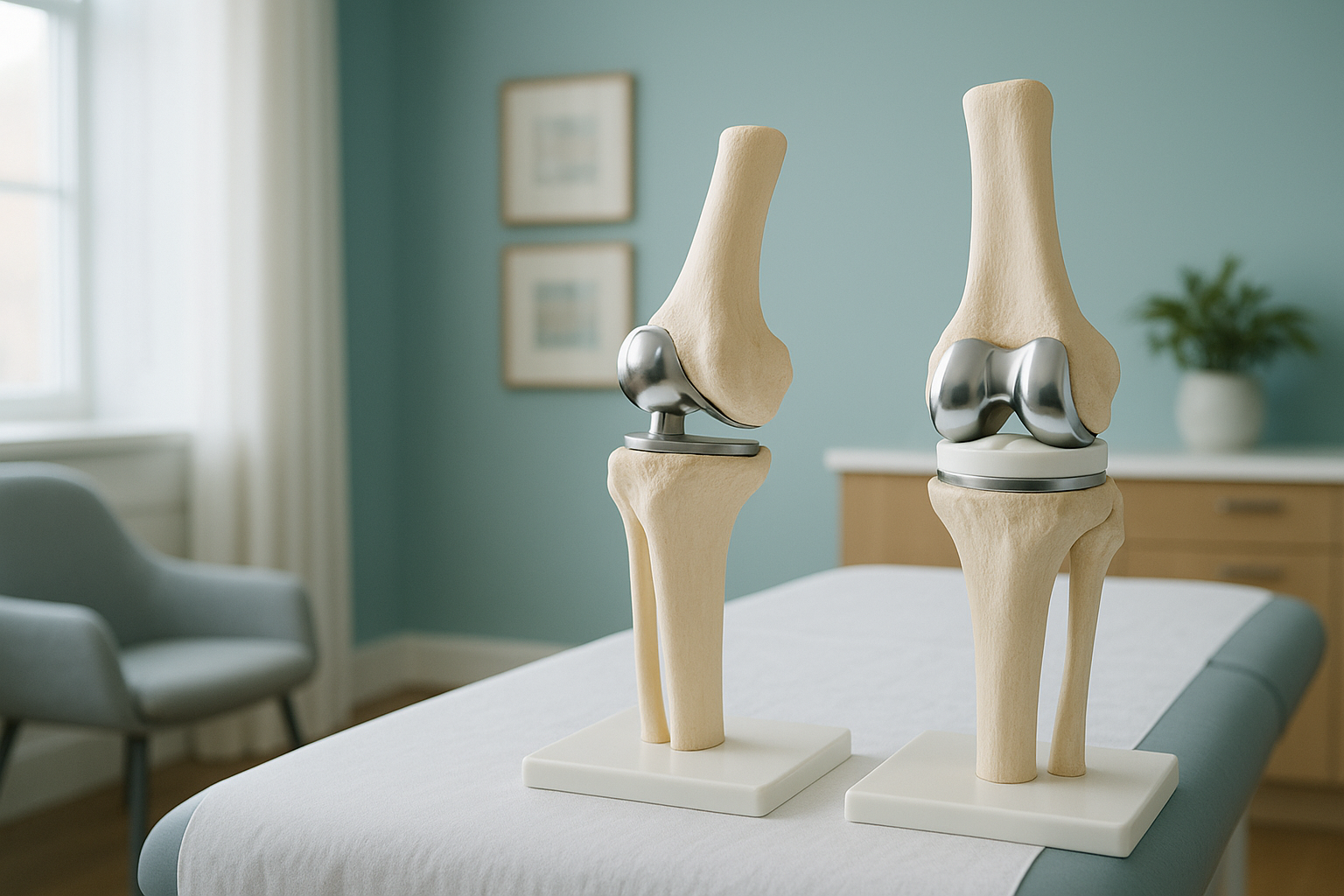
Staged replacement is more common. Your surgeon replaces the worst joint first, allows you to recover and rehabilitate, then schedules the second operation. This spreads out the physical stress and lets your body heal between procedures.
Simultaneous replacement means one anaesthetic, one hospital stay and one rehabilitation period. It can suit people who are otherwise fit and whose joints are equally affected. However, it carries higher surgical risk and is not suitable for everyone.
In either case, the order in which joints are replaced matters. Surgeons often choose based on which joint is more damaged, but alignment plays a crucial role too. A poorly aligned hip can change the angle at which your knee bears weight, so replacing the knee first without understanding the hip alignment could lead to less-than-ideal outcomes.
Why does whole-body alignment matter before joint replacement?
Whole-body alignment matters because your hip, knee, ankle and spine work as a connected chain. A change in one part shifts how every other part bears load. If your surgeon only sees the single joint in isolation, they may miss the bigger picture that affects implant positioning and long-term function.
When you stand, gravity pulls through your body in a specific pattern. If your pelvis tilts, your thigh bone sits at a different angle, which changes the forces through your knee. If your knee is already arthritic and stiff, it pushes extra strain back up to the hip and down to the ankle.
Most standard imaging, such as X-rays, CT or MRI, is done with you lying down. In that position, your muscles relax and your joints settle differently than when you are upright and bearing your own weight. This means lying-down scans can underestimate or miss the misalignment that causes your symptoms during everyday activities like walking and standing.
Understanding how your hip and knee affect each other starts with seeing the full picture. Learn more about hip alignment imaging and why it matters before surgery.
How does an EOS scan help plan a hip and knee replacement?
An EOS scan captures your entire skeleton from head to feet in a single standing image. This gives your surgeon a true weight-bearing view of how your hip, knee, pelvis, spine and ankles relate to one another under gravity.
Because the scan is taken while you stand, it reveals the real-world alignment your body uses every day. Your surgeon can see whether your pelvis tilts, whether your leg length differs from side to side, and how your knee and hip angles interact. All of this information helps them plan implant size, angle and positioning more precisely.
EOS also uses about 90% less radiation than a standard X-ray, around ten times less. That lower dose is especially useful when you need multiple scans over the course of planning, pre-operative assessment and post-operative follow-up.

To learn more about how EOS standing imaging works and what it involves, visit the EOS scan overview.
A note on MRI. EOS shows bones, joints and alignment in full standing position. For soft tissue, discs or nerves, MRI is usually the better tool. Your surgeon may request both types of imaging for a complete assessment.
Who should consider standing alignment imaging before double joint replacement?
Anyone facing hip and knee replacement on the same side, or even on different sides, can benefit from understanding their full alignment before surgery. It is particularly relevant if previous scans have not fully explained your symptoms or if your surgeon wants to plan implant positioning carefully.
- Need both hip and knee replacement and want to understand the sequence
- Have pain that moves between your hip and knee
- Have a limp or leg-length difference you have been told about
- Have had one joint replaced and the other still causes problems
- Want your surgeon to have a full weight-bearing view before operating
- Have sudden severe joint swelling, redness or fever (seek urgent medical attention)
- Need soft-tissue or nerve assessment only (MRI is more appropriate)
- Have not yet seen a GP or specialist about your joint pain
- Are looking for treatment rather than diagnostic imaging
For details on knee alignment imaging, including what the scan covers and how it helps surgical planning, see our dedicated knee page.
Frequently asked questions
Yes, simultaneous hip and knee replacement is possible. However, it is less common than staged surgery and carries higher surgical risk. Your orthopaedic surgeon will decide based on your overall fitness and the severity of both joints.
There is no single rule. Surgeons often replace the more damaged or painful joint first. Alignment imaging can help because a tilted pelvis or hip angle may be affecting how the knee sits, which influences the decision.
Most surgeons allow several weeks to a few months between the two operations, giving you time to recover and build strength. The exact interval depends on how quickly you rehabilitate and your surgical team's recommendation.
Your hip, knee, pelvis and spine form a connected chain. If alignment is off in one area, it changes how the new joint bears weight. Accurate alignment data helps your surgeon position implants for better function and longevity.
An EOS scan is a standing, weight-bearing X-ray that captures your whole skeleton from head to feet in one image. It shows real-world alignment under gravity, which standard lying-down imaging cannot provide.
Yes. EOS uses about 90% less radiation than a standard X-ray, around ten times less. This makes it one of the lowest-dose imaging options available for full skeletal assessment.
No. ScanAlign is a private, self-pay clinic. You can book directly without a GP or consultant referral. Many people self-refer to get imaging that informs a conversation with their surgical team.
For current pricing and what is included, please visit our FAQs and cost page.
EOS and MRI show different things. EOS is ideal for bones, joints and standing alignment. MRI is better for soft tissue, cartilage and nerves. Your surgeon may need both for a complete pre-surgical picture.
You stand in the EOS scanner for a brief scan. There is no injection, no enclosed tunnel and no need to lie down. The images are reviewed by a specialist diagnostic radiographer, and a detailed report is produced for you and your clinician. For full details, see our what to expect page.
See how your hip and knee alignment connect
A free video consultation lets you discuss your situation, ask questions and find out whether standing alignment imaging could help your surgical planning.
Book a free video consultationAuthor: Abbas Dhami (Specialist Diagnostic Radiographer)
Sources
- National Institute for Health and Care Excellence (NICE). Joint replacement (primary): hip, knee and shoulder. NICE guideline [NG157], 2020.
- Illés, T. and Somoskeöy, S. "The EOS imaging system and its uses in daily orthopaedic practice." International Orthopaedics, 36(7), 2012, pp. 1405–1411.
- NHS. Hip replacement: overview. nhs.uk, reviewed 2022.
This page is general information and not a diagnosis.
ScanAlign is the trading name of CoreMed Solutions Ltd and operates under The Harley Street Hospital's CQC licence.