
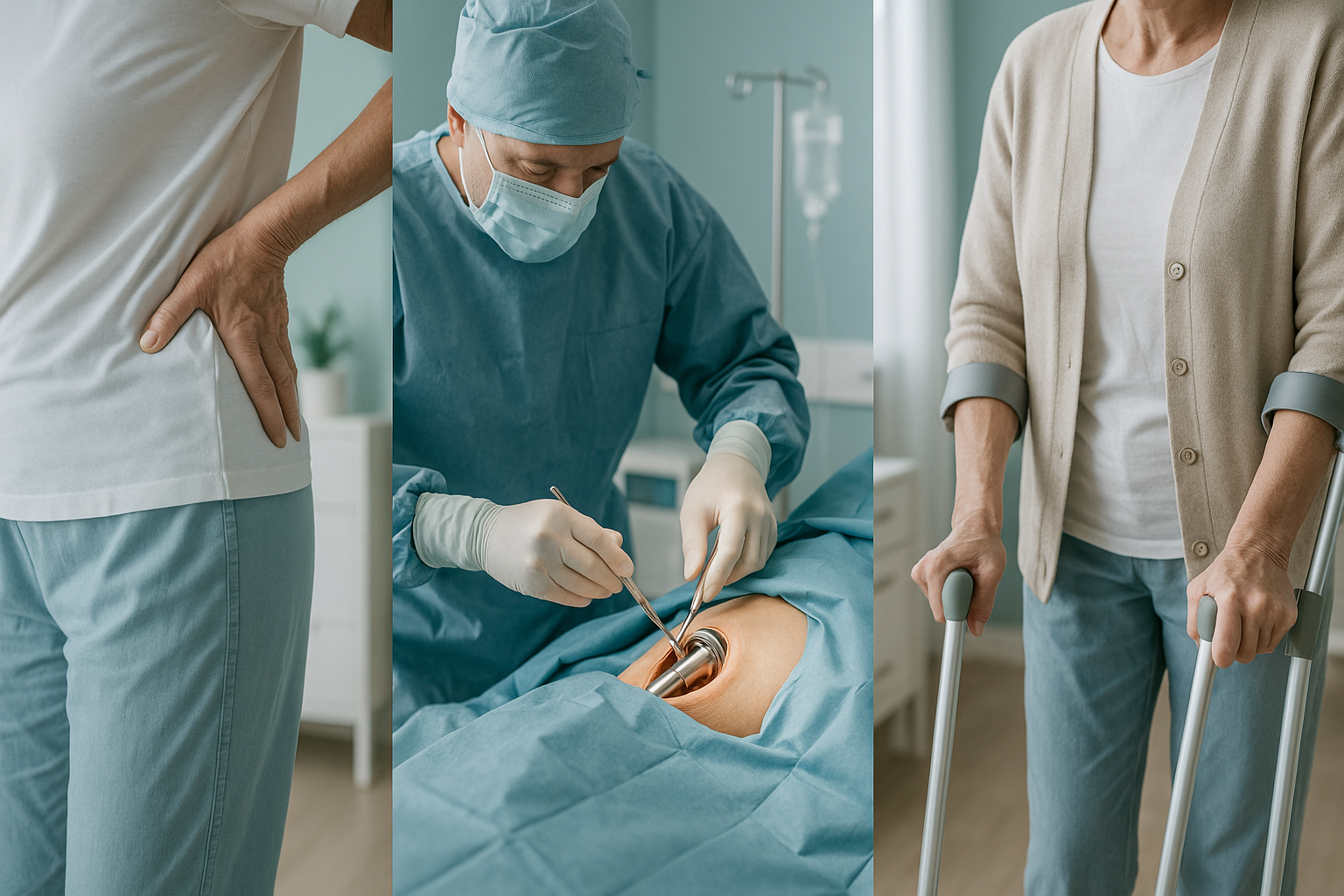
Hip Replacement: What Happens Before, During and After Surgery?
A hip replacement, also called hip arthroplasty, is a surgical procedure that removes a damaged hip joint and replaces it with an artificial one. It is one of the most common joint operations in the UK. Success depends heavily on accurate pre-operative imaging, particularly of your alignment while standing and bearing weight.
Key takeaways
- Hip replacement surgery replaces a worn or damaged hip joint with artificial components.
- Osteoarthritis is the most common reason people need a hip operation.
- Standing, weight-bearing imaging reveals alignment that lying-down scans can miss, helping surgeons plan more precisely.
- Recovery typically takes several months, with gradual return to daily activities.
- EOS imaging uses about 90% less radiation than a standard X-ray, around ten times less.
What is a hip replacement?
A hip replacement is a surgical procedure where a damaged hip joint is removed and replaced with an artificial joint made from metal, ceramic or plastic. The operation addresses the ball-and-socket joint where the top of your thigh bone (femur) meets your pelvis. When the cartilage lining this joint wears away, bone rubs on bone, causing pain, stiffness and loss of mobility.
There are two main types. A total hip replacement replaces both the ball and the socket. A partial (or hemi) replacement replaces only the ball. Your surgeon will recommend the right approach based on your imaging and the extent of joint damage.
How do you know if you need a hip replacement?
You may need a hip operation when your hip pain significantly affects your daily life and non-surgical options are no longer working. Common signs include the following.
Hip or groin pain that does not ease with rest or pain relief, especially at night.
Difficulty putting on shoes, getting in and out of a car or walking up stairs.
Walking with a limp, relying on a stick, or avoiding activities you used to enjoy.
Knee, lower back or opposite hip pain caused by your body compensating for the damaged joint.
What causes the need for a hip operation?
The most common cause is osteoarthritis, where the cartilage cushioning the joint gradually breaks down over years. Other causes include the following.
Age-related wear and tear on the hip joint cartilage.
An autoimmune condition that inflames and damages the joint lining.
A break in the top of the thigh bone, often from a fall.
Loss of blood supply to the femoral head, causing the bone to weaken.
Why does standing imaging matter before a hip replacement?
Standing, weight-bearing imaging shows your surgeon how your hip, pelvis, spine and legs align under the real forces of gravity. This is the position your body actually works in. When you lie down for a standard X-ray, CT or MRI, your muscles relax, your pelvis shifts and alignment problems can be hidden.
Your body works as a connected chain. A worn hip changes how you stand, which tilts your pelvis, which changes your spinal curves and puts extra load on your opposite knee. A single-area scan of just the hip can miss this bigger picture. Standing whole-body imaging captures everything from your spine to your ankles in one image, while you are upright and bearing weight.
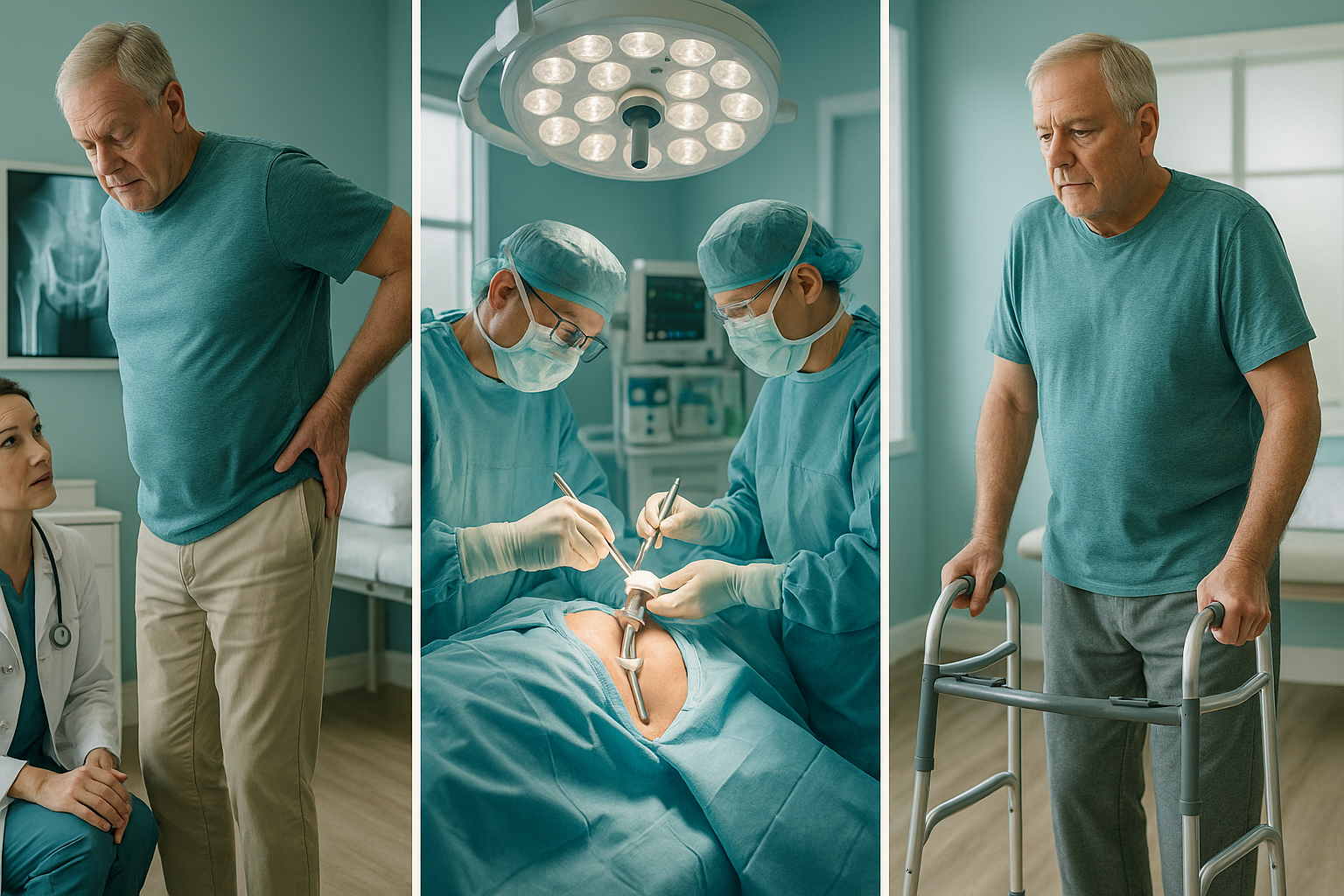
EOS imaging captures this standing view using about 90% less radiation than a standard X-ray, around ten times less. The result is a detailed, full-length image your surgeon can use to plan the replacement with greater precision, including the correct positioning and sizing of the artificial joint.
Want to understand how standing imaging could support your hip replacement planning?
Book a free video consultationWhat happens during hip replacement surgery?
Hip replacement surgery is performed under general or spinal anaesthetic and usually takes between one and two hours. The surgeon removes the damaged bone and cartilage, then fits the artificial joint components. These are shaped to replicate the natural movement of the hip.
Precise pre-operative imaging helps the surgical team select the right implant size, plan the angle of placement and account for any pelvic tilt or leg-length difference. These factors directly affect how the replacement feels and functions afterwards.
What is hip replacement recovery time like?
Recovery from a total hip replacement is gradual. Most people are up and walking with support within a day of surgery. You can usually return to light daily activities within six to twelve weeks, though full recovery can take several months.
After surgery, follow-up imaging can check how the replacement is settling and whether your overall alignment has improved. A standing scan is particularly useful here, because it shows the implant under real load rather than while you are lying on a table.
When is MRI the better choice? EOS shows bones, joints and alignment clearly. For soft tissue, discs or nerves, MRI is usually the better tool. If your surgeon suspects a labral tear or soft-tissue damage around the hip, they may recommend MRI alongside alignment imaging. The two are complementary.
- Are considering or are booked for hip replacement surgery
- Have hip pain alongside back or knee problems
- Want a pre-operative alignment assessment
- Need post-operative imaging with low radiation
- Have a leg-length difference you want measured accurately
- Sudden severe hip pain after a fall or injury
- Numbness or weakness in your leg
- Loss of bladder or bowel control
- A hot, red, swollen joint with fever
Contact your GP, call 111 or go to A&E.
Frequently asked questions about hip replacement
Modern hip replacements are designed to last many years. Longevity depends on factors like your activity level, weight and the type of implant used. Your surgeon can give you a realistic expectation based on your individual situation.
No. At ScanAlign you can self-refer. You do not need a GP or consultant referral to book a scan. Many people come to us before or after seeing their surgeon.
Yes. EOS uses about 90% less radiation than a standard X-ray, around ten times less. You can find more detail on our FAQs page.
ScanAlign is a self-pay clinic. For current pricing, please visit our FAQs and pricing page.
Yes. A whole-body standing image captures your full alignment from spine to ankles. It can reveal how a damaged hip has caused your pelvis to tilt, putting extra strain on your opposite hip, knee or lower back. Pain in a connected area is often the result of compensation.
A total hip replacement replaces both the ball (femoral head) and the socket (acetabulum). A partial replacement, sometimes called a hemi-arthroplasty, replaces only the ball. Your surgeon recommends the best option based on the damage visible on imaging.
The angle and position of the new joint affect how it functions, how long it lasts and whether you feel balanced afterwards. Standing imaging shows your true pelvic tilt and leg lengths under gravity, giving the surgical team accurate data that lying-down scans may not capture.
The surgery itself usually takes between one and two hours. You will typically stay in hospital for one to three days afterwards, depending on how quickly you recover.
Yes. Post-operative standing imaging is useful for checking implant position under load and assessing whether your overall alignment has improved. EOS works well with metal implants and uses very low radiation.
You stand still inside the EOS machine for about 20 seconds while it takes a full-length image. There is no enclosed tunnel and no need to undress fully. The whole visit is quick and straightforward. More details are on our what to expect page.
Considering a hip replacement?
A standing alignment assessment can give you and your surgeon the full picture before and after surgery.
Book a free video consultationRelated pages
Written by Abbas Dhami (Specialist Diagnostic Radiographer)
Sources
- National Institute for Health and Care Excellence (NICE). Joint replacement (primary): hip, knee and shoulder. NICE guideline [NG157], 2020.
- NHS. Hip replacement overview. nhs.uk, 2022.
- Lazennec JY, Brusson A, Rousseau MA. Hip-spine relations and sagittal balance clinical consequences. European Spine Journal, 2011;20(Suppl 5):686-698.
This page is general information and not a diagnosis.
ScanAlign is the trading name of CoreMed Solutions Ltd and operates under The Harley Street Hospital's CQC licence.