
Back Pain Clinic: What Should You Expect from an Assessment?
A back pain clinic assessment typically includes a detailed history, a physical examination and, where needed, imaging. The goal is to find out what is causing your pain, not just where it hurts. Standing, whole-body imaging can reveal alignment problems that standard lying-down scans often miss.
Key takeaways
- A thorough back clinic assessment looks at your whole body, not just the painful area.
- Back pain often develops because one part of the body compensates for a problem elsewhere.
- Standing imaging shows how your spine and pelvis behave under your own body weight.
- EOS imaging uses about 90% less radiation than a standard X-ray, around ten times less.
- You do not need a GP referral to book a private consultation at ScanAlign.
If you have been living with back pain for weeks or months, you already know how frustrating it can be. Pain that does not go away, stiffness every morning, a nagging ache that moves around. You may have tried painkillers, exercises or rest, but nothing has given you a clear answer about what is actually going on.
A back pain clinic exists to do exactly that. It provides a structured assessment designed to identify the source of your problem, so that whoever treats you has the information they need to help.
When should you visit a back pain clinic?
You should consider visiting a back clinic when your pain has persisted for more than a few weeks, keeps returning, or is affecting your daily life. Here are common signs that an assessment could help.
Back pain lasting more than four to six weeks that has not improved with rest or basic painkillers.
Pain that settles and then flares up again, sometimes in slightly different places each time.
Difficulty sitting at work, sleeping comfortably, exercising or carrying out everyday tasks.
Back pain that spreads into the hips, buttocks or legs, suggesting the cause may not be where you feel it most.
Important: seek urgent help if you experience any of the following. Numbness or tingling in both legs, loss of bladder or bowel control, sudden weakness in your legs, or severe pain after an injury. Contact your GP, call 111, or go to A&E straight away. These symptoms need immediate medical attention, not a routine back clinic appointment.
What happens at a back pain assessment?
A good back pain assessment follows a clear process. It starts with understanding your history, moves to a physical examination, and then uses imaging where appropriate to build a complete picture.

1. Your history
The clinician will ask about when the pain started, what makes it better or worse, how it affects your work and sleep, and whether you have had any previous treatment or scans. This conversation often reveals patterns you may not have noticed yourself.
2. Physical examination
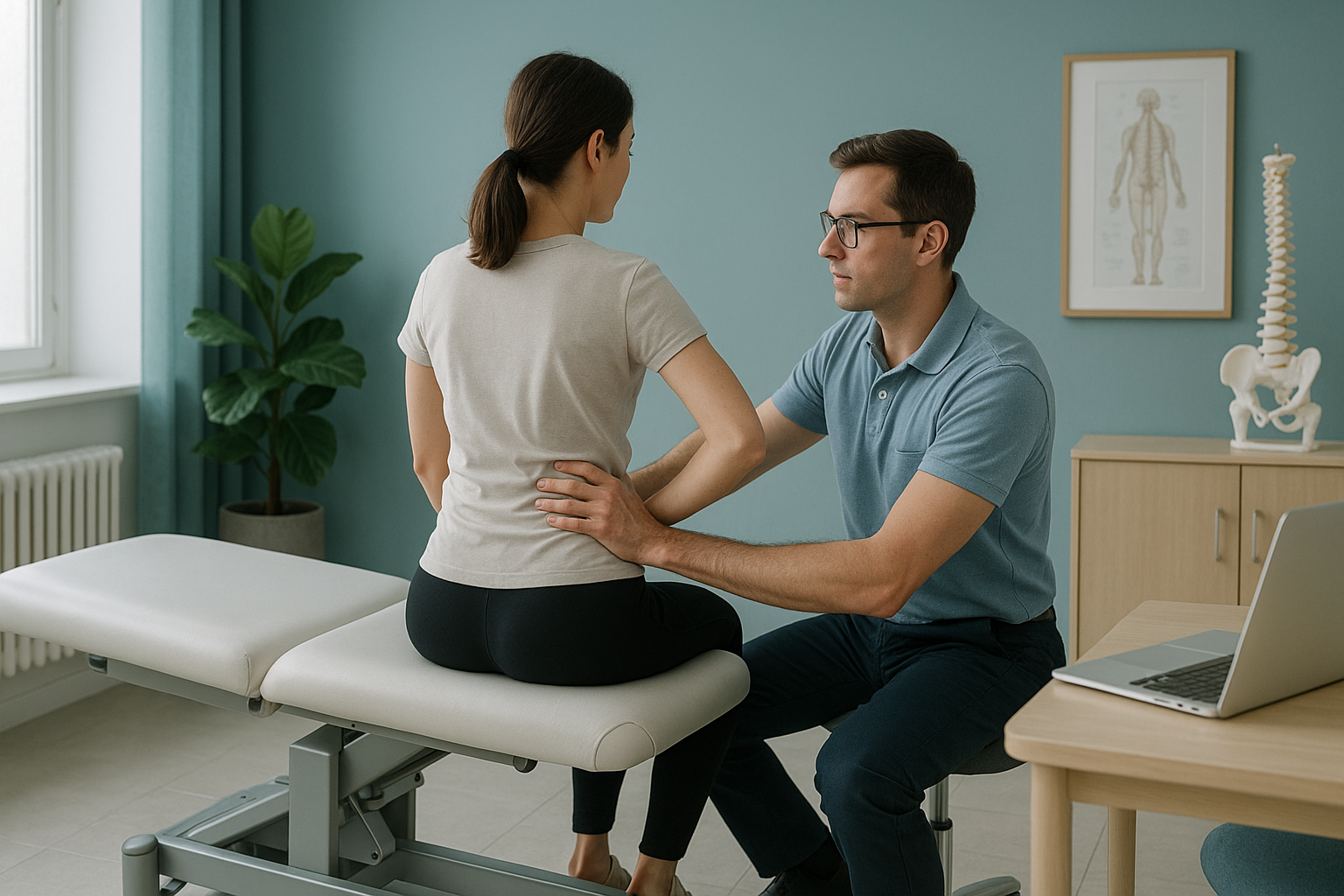
You will be asked to stand, move and bend so the clinician can assess your range of motion, posture and muscle balance. They may test reflexes, sensation and strength in your legs to check whether nerves are involved.
3. Imaging
If imaging is appropriate, it provides an objective view of your bones, joints and alignment. The type of imaging matters. Most standard scans are taken while you are lying down, which changes the way your body is loaded. A standing scan shows what your spine really looks like when gravity is acting on it, the position you spend most of your day in.
Why does standing imaging matter for back pain?
Standing imaging matters because it captures your skeleton under your own body weight, showing alignment problems that disappear when you lie down. When you lie flat for a standard X-ray, CT or MRI, your muscles relax and gravity stops pulling on your joints. Your spine may look relatively normal in that position, even if it is not behaving normally when you are upright.
Your body is a connected chain. A slight pelvic tilt, a leg length difference, or a shift in your hip alignment can force your spine to compensate. Over time, that compensation leads to strain, wear and pain. The pain may appear in your lower back, but the root cause could be in your pelvis, hip or even lower. A whole-body standing image captures all of this in a single scan.
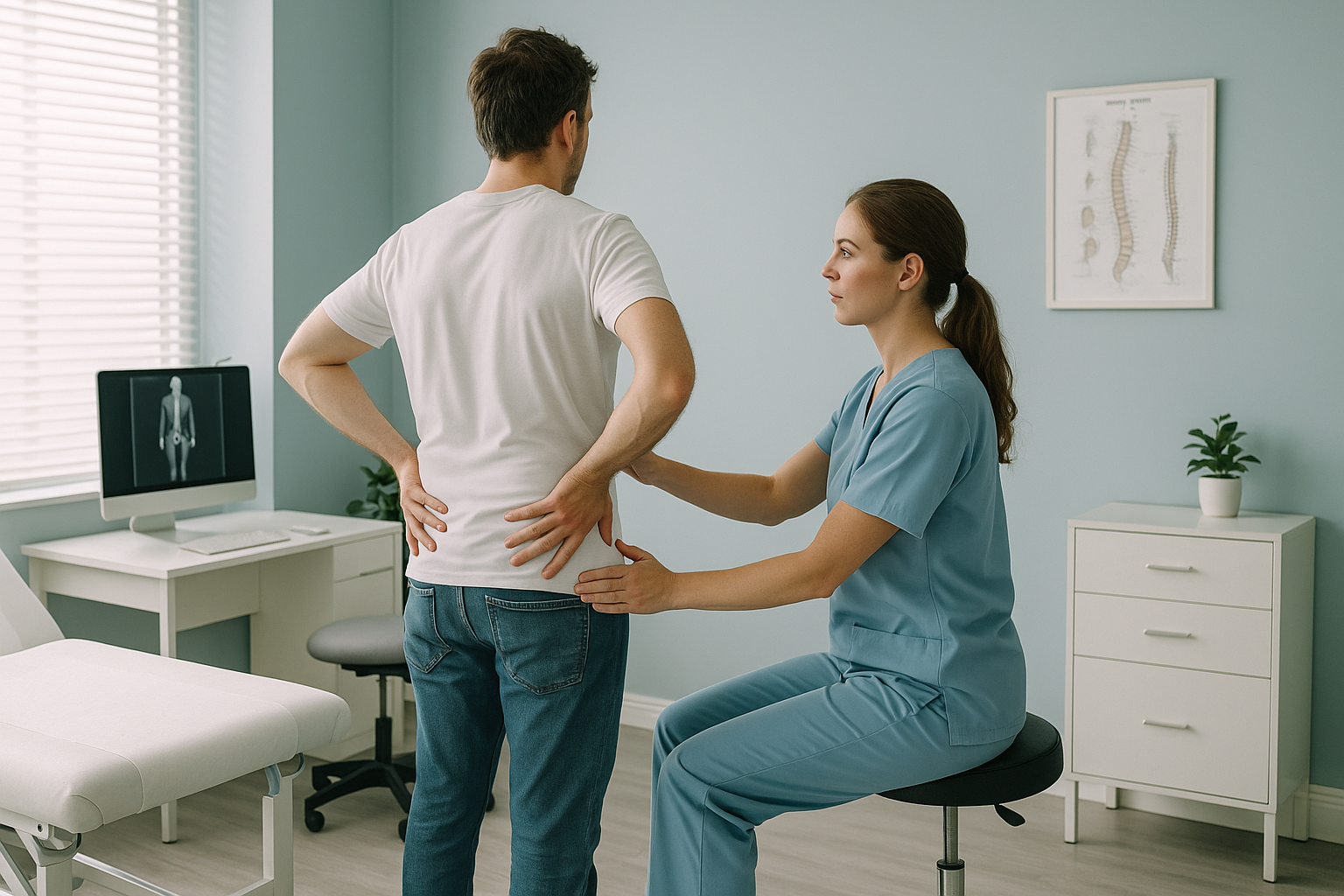
EOS is a type of low-dose standing X-ray that captures a full-length image of your skeleton from head to feet in one go. It uses about 90% less radiation than a standard X-ray, around ten times less. This makes it practical for whole-body scanning while keeping radiation exposure very low.
The result is a detailed map of your alignment that your specialist can use to plan treatment precisely. You can learn more about how EOS whole-body imaging works.
When is MRI the better choice? EOS shows bones, joints and alignment brilliantly. For soft tissue, discs or nerves, MRI is usually the better tool. If your clinician suspects a disc problem or nerve compression, they may recommend MRI alongside or instead of a standing scan. The two types of imaging often complement each other.
Is a private back pain clinic right for you?
A private back clinic is a good fit if you want a thorough assessment without a long wait, or if previous investigations have not given you a clear answer. It is not the right route for everyone.
- Back pain lasting more than four to six weeks
- Pain that travels into the hips, buttocks or legs
- Previous scans that showed "nothing wrong" but pain persists
- A posture or alignment concern raised by a physiotherapist or osteopath
- Pain after a previous spinal or joint procedure that has not settled
- Your pain is new and mild, and is improving on its own
- You have not yet tried basic self-management (movement, gentle exercise)
- You need emergency care for red-flag symptoms (see above)
Not sure whether a standing scan would help your back pain? ScanAlign offers a free video consultation to talk through your situation before you commit to anything.
Book a free video consultationAt ScanAlign, you do not need a GP referral. You can self-refer directly. The clinic is located at 19 Harley Street, London and specialises in EOS standing whole-body imaging. It is a diagnostic imaging service, so the scan and report give you and your treating clinician the information needed to plan the right next step. For details on cost, safety and what to expect, visit the FAQs page.
What areas of the body can affect your back pain?
Because the body works as a connected chain, problems in one area often produce pain in another. A back clinic assessment should consider these related areas.
Frequently asked questions about back pain clinics
Not at ScanAlign. You can self-refer directly and book a free video consultation without needing a letter from your GP. If you do have a referral, you are welcome to bring it along.
A physiotherapist focuses on movement and exercise-based rehabilitation. A back clinic assessment may include imaging to identify structural or alignment problems that manual examination alone cannot detect. The two services often work well together.
EOS is a low-dose standing X-ray that captures a full-length image of your skeleton from head to feet. It shows how your bones and joints are aligned while you are weight-bearing, which is essential for understanding back pain caused by alignment issues.
Yes. EOS uses about 90% less radiation than a standard X-ray, around ten times less. This makes it one of the lowest-dose skeletal imaging options available.
For up-to-date pricing, please visit the ScanAlign FAQs page. The initial video consultation is free and there is no obligation to proceed.
They look at different things. MRI is excellent for soft tissue, discs and nerves. A standing EOS scan shows bony alignment and how your skeleton behaves under gravity. Alignment problems can be invisible on a lying-down MRI because the body is in a completely different position.
Wear comfortable clothing without metal fastenings such as zips or buttons. You may be asked to change into a gown for imaging. Avoid jewellery around the areas being scanned.
ScanAlign provides diagnostic imaging and a detailed report. This report gives you and your treating clinician the information needed to reach a diagnosis and plan treatment. ScanAlign itself does not prescribe treatment.
The EOS scan itself is very quick. You simply stand still in the scanner for a short time while the images are captured. The whole appointment, including any consultation, takes longer. Details are on the FAQs page.
ScanAlign is based at 19 Harley Street, London, within The Harley Street Hospital. The clinic is easily accessible by public transport, with several Underground stations nearby.
Ready to understand your back pain?
Book a free video consultation to discuss your situation with a specialist. No referral needed, no obligation.
Book a free video consultationSources
- National Institute for Health and Care Excellence (NICE). Low back pain and sciatica in over 16s: assessment and management (NG59). 2016, updated 2020.
- Illés, T. et al. "The EOS imaging system and its uses in daily orthopaedic practice." International Orthopaedics, 36(7), 2012, pp. 1325–1331.
- NHS. "Back pain: causes, treatment and when to see a GP." nhs.uk, 2023.
Written by Abbas Dhami (Specialist Diagnostic Radiographer)
This page is general information and not a diagnosis.
ScanAlign is the trading name of CoreMed Solutions Ltd and operates under The Harley Street Hospital's CQC licence.